
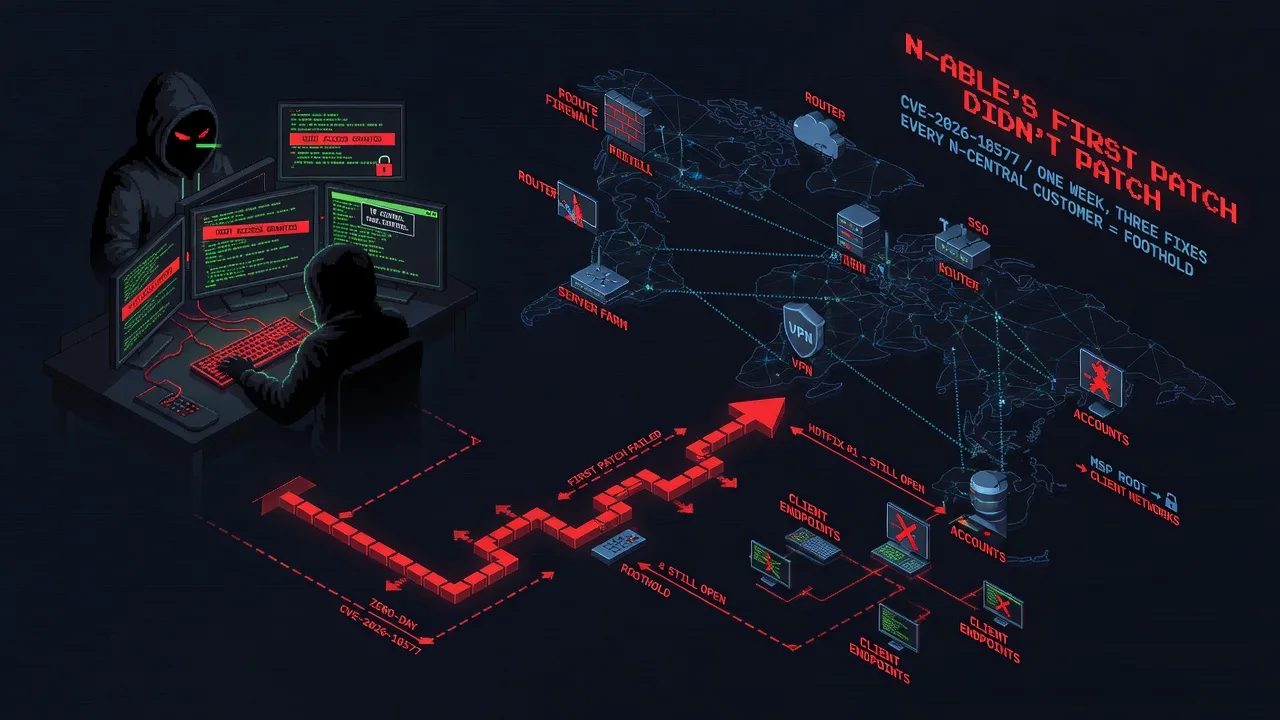
N-Able's First Patch Didn't Patch — CVE-2026-18577 Turns Every N-central Customer Into a Foothold
A zero-day exploited before the fix shipped, a hotfix that didn't close the hole, and a second hotfix three days later — all inside one week, on an MSP tool with root over every managed endpoint
One tool, every customer's network
N-central is the console MSPs use to manage hundreds of client networks from one screen — patching, monitoring, and, critically, a built-in remote-access feature called Take Control. That design is exactly why an authentication bypass in N-central isn't a single-tenant incident. In the last week of July and first week of August 2026, N-able shipped a patch for one authentication-bypass bug, discovered days later that the patch didn't actually close it, and shipped a second emergency hotfix while CISA ran a 3-day federal deadline clock in the background.
Scores as of 2026-08-08live record →
The patch that didn't patch
These are two separate CVE records describing the same failure mode twice. CVE-2026-18556 is an authentication-bypass-using-an-alternate-path-or-channel flaw (CWE-288) affecting N-central through version 2026.1, CVSS 7.4. CVE-2026-18577 is N-able's own description of what happened next: "an incomplete patch for CVE-2026-18556 allows for authentication bypass and account takeover in N-central Versions through 2026.3.1." Same bug class, same CWE-288, higher score (8.1) because the second bypass path was easier to reach (AC:H stayed, but the practical exploitation path attackers used required no special conditions).
| CVE-2026-18556 | CVE-2026-18577 | |
|---|---|---|
| What it is | Original auth-bypass to admin | Bypass of the fix for the original bug |
| CWE | CWE-288 (auth bypass, alternate path) | CWE-288 (auth bypass, alternate path) |
| CVSS 3.1 | 7.4 (AV:N/AC:H/PR:N/UI:N/S:U/C:H/I:H/A:N) | 8.1 (AV:N/AC:H/PR:N/UI:N/S:U/C:H/I:H/A:H) |
| Affected versions | N-central through 2026.1 | N-central through 2026.3.1 (before Hotfix 1) |
| Fix | Rolled into the 2026.2/2026.3 line | Hotfix 1 (2026.3.1.7), superseded by Hotfix 2 (2026.3.1.10) |
| In CISA KEV | Yes — added alongside 18577 | Yes — added 2026-08-03, due 2026-08-06 |
The timeline: exploited before the first patch even shipped
CVE-2026-18556 / CVE-2026-18577, end to end
- N-central 2026.3.0 releasedRegular release; the version Hotfix 1 would later be built on top of.
- Adlumin MDR detects active exploitationA threat actor is caught exploiting the still-unpatched authentication bypass in a live N-central server — the flaw was being used as a zero-day.
- CVE-2026-18556 publishedNVD/CVE record published, CVSS 7.4, affecting N-central through 2026.1.
- Hotfix 1 ships — and CVE-2026-18577 is published the same dayN-able releases build 2026.3.1.7 to close the original bug. N-able simultaneously discloses that the fix is incomplete: CVE-2026-18577, CVSS 8.1.
- CISA adds CVE-2026-18577 to the KEV catalogFederal civilian agencies given until 2026-08-06 to remediate.
- Hotfix 2 ships (build 2026.3.1.10)Supersedes Hotfix 1 with additional hardening — and lands on the same day as the KEV deadline.
What attackers actually did with it
Per N-able's own incident notes and reporting from Huntress and The Hacker News, the abuse pattern after gaining admin access on an N-central server was consistent: attackers connected using MSP Support, a default username tied to legitimate N-central Take Control sessions, then used Take Control itself to pivot into managed customer endpoints — no separate exploit needed once inside, because Take Control is a first-class, trusted feature of the product. On endpoints, they registered a service named Cloudflared (the real, legitimate Cloudflare tunneling binary, repurposed as a covert outbound channel) and, per N-able's incident guidance, investigators are told to check user documents folders for a planted file named svchost.exe — living-off-the-land naming meant to blend into a Windows process list at a glance.
From one N-central bypass to every managed endpoint
- Auth bypass on N-central server — CVE-2026-18556 / CVE-2026-18577, no valid credentials needed
- Admin session as "MSP Support" — Default username tied to legitimate Take Control sessions
- Take Control pivot — Legitimate RMM feature used to reach managed endpoints — not a separate exploit
- Cloudflared tunnel service registered — Persistence that survives revocation of N-central access
- svchost.exe dropped in user docs folder — Living-off-the-land naming for on-host persistence
- Domain controller recon, lateral movement — Per Huntress: high-value host enumeration, process listing, then movement to additional hosts
Not the first time — same product, almost the same week, one year apart
N-central has a KEV history. In August 2025, CISA added two other N-central flaws to the catalog: CVE-2025-8876, an OS command-injection bug (CVSS 8.8), and CVE-2025-8875, an insecure-deserialization bug (CVSS 7.8) — both published 2025-08-14, both affecting N-central before 2025.3.1, both exploited in what reporting at the time described as limited on-premises attacks. This year's pair landed within a day of each other, in the same first week of August, in the same product line. That's not proof of a pattern in the bug class — a command-injection RCE and an authentication-bypass chain are different failure modes — but it is a second consecutive year where N-central's on-prem deployment was a live KEV entry in early August, which is worth an MSP's attention independent of any single CVE.
| Label | CVSS score | EPSS % |
|---|---|---|
| CVE-2025-8876 (Aug 2025) | 8.8 | 3.1 |
| CVE-2025-8875 (Aug 2025) | 7.8 | 1.6 |
| CVE-2026-18556 (Aug 2026) | 7.4 | 0.5 |
| CVE-2026-18577 (Aug 2026) | 8.1 | 4.1 |
What to actually do
- Confirm you are on build 2026.3.1.10 (Hotfix 2) — not just 2026.3.1.7 (Hotfix 1), which N-able itself says was incomplete.
- Check the 4 published IOC addresses (173.249.252[.]200, 87.249.138[.]34, 37.19.210[.]32, 68.235.46[.]214) against your N-central server's access and firewall logs.
- Search endpoints managed through N-central for a service named "Cloudflared" that you did not deploy, and for a file named svchost.exe sitting in a user's Documents folder rather than System32.
- Audit Take Control session history for connections under the "MSP Support" account you did not initiate.
- Treat a clean scan as inconclusive, not clearance — N-able's own guidance says as much. If Take Control access was live during the exposure window, assume every endpoint reached through it needs its own review.
Vulnerability data as of 2026-08-08live record →