
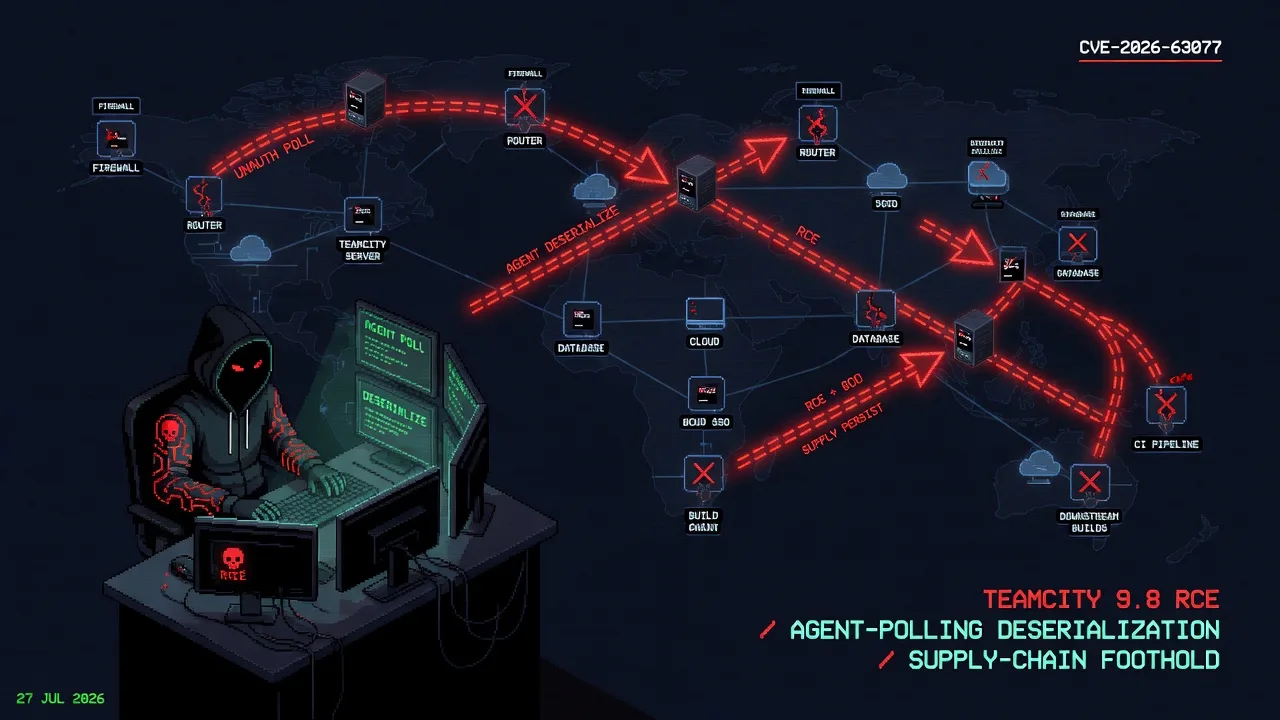
JetBrains TeamCity's unauthenticated 9.8: CVE-2026-63077 turns the channel you trust into RCE
A pre-exploit breakdown of the agent-polling deserialization flaw — and why RCE on a build server is a supply-chain foothold, not one box.
A build server is not one box
On July 27, 2026, JetBrains disclosed CVE-2026-63077 — an unauthenticated remote code execution flaw in TeamCity On-Premises. It is rated CVSS 9.8, and all an attacker needs is network reach to your build server. That server is where your organisation keeps its signing keys, deploy credentials and source code — which is why one RCE here is really a foothold into everything TeamCity builds and ships.
Scores as of 2026-08-04live record →
The flaw lives in TeamCity's agent polling protocol — the channel build agents use to talk to the central server — and is classified CWE-502, deserialization of untrusted data. A crafted message to that endpoint is deserialized before the sender ever authenticates, and the server ends up executing attacker-controlled code in the context of the TeamCity server process.
The channel you were told to trust
TeamCity agents poll the server: the build agent opens the connection outward and asks for work. Because the agent initiates that TCP connection, it is tempting to assume the protocol is an internal, agent-only affair. It is not. The server still receives, parses and responds to whatever arrives on that channel — and it does so before it has established who is on the other end.
Why a foothold here is a supply-chain foothold
One RCE, whole-pipeline reach
- Unauthenticated attacker
- Agent polling endpoint
- Code exec as TeamCity server
- Signing keys, deploy creds, source
- Poisoned build artifacts
- Every downstream consumer
TeamCity has been a target before
This is not TeamCity's first critical, unauthenticated bug — and the last ones did not stay theoretical. CVE-2023-42793, an authentication-bypass-to-RCE, was mass-exploited and abused by nation-state actors to backdoor build servers. CVE-2024-27198, another auth bypass, was weaponized within days of disclosure. Both now sit at the very top of the EPSS scale.
| Label | Value |
|---|---|
| CVE-2026-63077 (new) | 0.6 |
| CVE-2024-27198 | 99.9 |
| CVE-2023-42793 | 100 |
Am I affected?
| Release branch | Affected | Fixed build / action |
|---|---|---|
| TeamCity 2026.x On-Premises | All builds before 2026.1.3 | Upgrade to 2026.1.3 |
| TeamCity 2025.11.x On-Premises | All builds before 2025.11.7 | Upgrade to 2025.11.7 |
| Older On-Premises (2017.1+) | Affected | Upgrade, or apply the official security patch plugin |
| TeamCity Cloud | Not affected | Mitigation already applied by JetBrains |
# External recon: is a TeamCity server reachable, and what build is it?curl -sk https://teamcity.example.com/login.html \ | grep -oiE 'TeamCity [0-9]{4}\.[0-9.]+'# Compare the result against the fixed builds: 2026.1.3 / 2025.11.7# (the footer/version string format varies by release — adjust the pattern)Fix it: patch, or isolate then patch
Two ways to close it — do the first; use the second only to buy time
- Upgrade to 2026.1.3 or 2025.11.7
- Or install JetBrains' official security patch plugin (TeamCity 2017.1+)
- The plugin fixes only this CVE — schedule the full upgrade anyway
- Restrict the server to trusted build-agent IP ranges
- Remove any internet exposure of the instance
- Front it with a VPN / allow-list until patched
- Inventory every TeamCity On-Premises server — including forgotten and staging instances.
- Prioritise anything reachable from the internet; patch those first.
- Upgrade to 2026.1.3 / 2025.11.7, or apply the security patch plugin if you cannot upgrade immediately.
- Rotate secrets the server can reach: signing keys, deploy tokens, VCS and cloud credentials.
- Review recent build logs and artifacts for tampering before trusting new releases.
What to watch while you patch
There is no public proof-of-concept and no confirmed in-the-wild exploitation as of this writing — which also means there is no ready-made signature to drop into your IDS. Detection here is behavioural, not signature-based.
- Unexpected child processes spawned by the TeamCity server process (shells, interpreters, network tools).
- Agent-polling traffic from source IPs that are not your known build agents.
- New or modified build steps, plugins or scheduled tasks you did not create.
- Outbound connections from the build server to unfamiliar destinations.
Disclosure timeline
- Reported to JetBrainsCredited to researcher Antoni Tremblay per vendor and press reporting.
- Advisory publishedJetBrains discloses CVE-2026-63077 and ships fixes in 2026.1.3 and 2025.11.7.
- No known in-the-wild exploitationEPSS ~0.6%; no public PoC observed. The pre-exploit window is still open.
Data as of 2026-08-04live record →