
The guardian is the gateway: 2026's exploited-bug list is a map of the security products we trusted
Firewall consoles, VPN gateways, the SD-WAN controller, the SIEM, the malware sandbox — this year's KEV additions keep landing on the machines we bought to keep us safe. The common thread isn't a bug class. It's a target class.
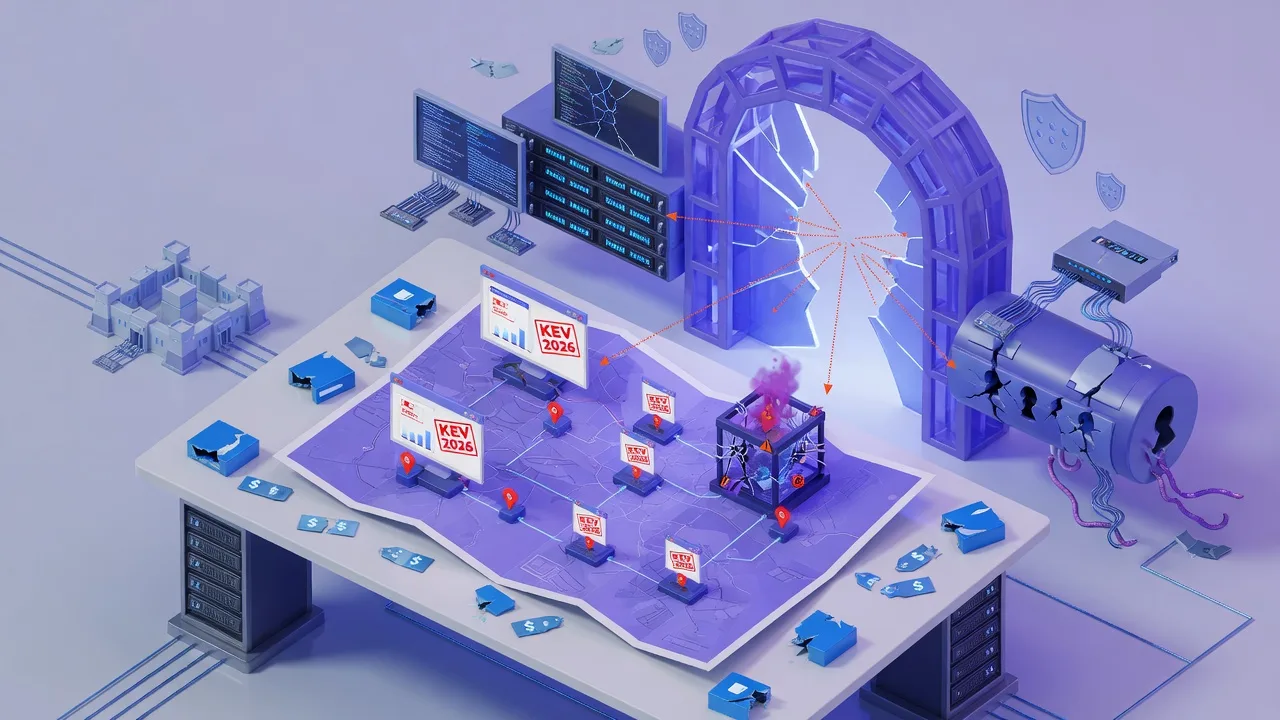
There is a comfortable story we tell ourselves about security spending. We buy a box — a firewall manager, a VPN gateway, a sandbox, a SIEM — and we quietly assume the attack surface just got smaller. One more guardian at the gate. For most of 2026, the exploited-in-the-wild list has been telling a different story, patiently and without drama: the guardians are the gate now, and attackers have been walking straight up to them.
Look at what CISA has added to its Known Exploited Vulnerabilities catalog this year and a pattern surfaces that has nothing to do with any single vendor. The most-attacked machines in 2026 are the ones we bought to defend and manage the network — the control plane, not the workloads it protects. The firewall's brain, not the firewall. The console, not the endpoint. The thing that watches, not the thing being watched.
The bugs are all different. The target isn't.
Here is the year's roster, laid out by what each machine is for. Read the last column slowly — it is the same sentence written eight ways.
| Product | What it does | CVE | The flaw | If it falls, the attacker gets… |
|---|---|---|---|---|
| Cisco Secure FMC | Pushes policy & software to every Firepower firewall | CVE-2026-20316 | Hard-coded credential | A foothold on the box that programs your firewalls |
| Check Point SmartConsole | Admin console for firewall policy | CVE-2026-16232 | Login-token bypass | Full admin to rewrite security policy |
| PAN-OS GlobalProtect | VPN portal & gateway | CVE-2026-0257 | Authentication bypass | An unauthorized VPN foothold inside the network |
| Cisco Catalyst SD-WAN Controller | Programs the whole SD-WAN fabric | CVE-2026-20182 | Auth bypass → admin | Config control of the fabric via NETCONF |
| SonicWall SMA1000 | Remote-access appliance | CVE-2026-15409 | SSRF (chains to root) | Root on an internet-facing access gateway |
| Ivanti Standalone Sentry | Mobile / MDM gateway | CVE-2026-10520 | OS command injection | Unauthenticated root on the device gateway |
| Splunk Enterprise | The SIEM | CVE-2026-20253 | Missing authentication | A pre-auth foothold on your detection plane |
| FortiSandbox | Malware detonation sandbox | CVE-2026-25089 | OS command injection | Pre-auth RCE on the box that inspects threats |
Scores as of 2026-08-04live record →
Why the guardian is the perfect target
Strip away the vendor logos and a management plane device has three properties an attacker dreams about. It is privileged — it exists precisely to command other machines. It is trusted — we route around it, allow-list it, and rarely point our own tools back at it. And it is reachable — a console you can't reach is a console you can't administer, so it sits at an edge, often facing the internet. Privileged, trusted, reachable: that is not a description of a defense. It is a description of a skeleton key.
The inversion: one console, the whole fleet
- Internet-facing console
- Auth bypass / static credential
- Admin on the management plane
- Rewrite policy · read secrets · push software
- Every managed device is yours
The score measures the bug. It can't price the box.
We like to sort these by CVSS and EPSS, and mostly that works. But watch what happens with Cisco's FMC static credential (CVE-2026-20316): CVSS 5.3, a Medium, and an EPSS of roughly 0.8% — near the floor of the probability scale. By the numbers it is a rounding error. It is on the KEV list anyway, because it lives on the machine that programs your firewalls. The model priced the bug correctly. It could not price the box.
| Label | Value |
|---|---|
| Ivanti Sentry (10520) | 99.9 |
| Splunk (20253) | 96.2 |
| PAN-OS GP (0257) | 93.9 |
| SD-WAN Ctrl (20182) | 90.3 |
| SonicWall SMA (15409) | 78.4 |
| Check Point (16232) | 71.4 |
| FortiSandbox (25089) | 69.8 |
| Cisco FMC (20316) | 0.8 |
A trajectory, not a season
One quarter is an anecdote. A year is a direction. Line the disclosures up by date and the cadence is steady — not a single bad Patch Tuesday, but a drumbeat across vendors and categories.
The 2026 cadence (by disclosure date)
- PAN-OS GlobalProtect authentication bypassThe VPN gateway — CVE-2026-0257
- Cisco Catalyst SD-WAN Controller auth bypassThe fabric's control plane — CVE-2026-20182
- Ivanti Sentry + FortiSandboxAn MDM gateway and a malware sandbox, same day — CVE-2026-10520, CVE-2026-25089
- Splunk Enterprise sidecarThe SIEM itself — CVE-2026-20253
- SonicWall SMA1000A remote-access appliance — CVE-2026-15409
- Check Point SmartConsoleThe firewall policy console — CVE-2026-16232
- Cisco Secure FMCThe firewall management brain — CVE-2026-20316
Why does the drumbeat keep getting louder? Because functionality almost always wins over caution, and management planes are where functionality accretes. Every release adds a console, a sidecar, a cloud tenant, an AI helper — a new privileged surface bolted onto a trusted box, shipped a little faster than it was hardened. We are building the control plane faster than we are defending it, and the exploited-bug list is simply the invoice arriving.
The inversion, in plain terms
- Shrink the attack surface
- Enforce one consistent policy everywhere
- Sit at a trusted choke point
- See and inspect everything
- Became the attack surface
- Let one bug rewrite policy everywhere
- Turned the choke point into a single point of takeover
- Handed the attacker the same total visibility
What to actually do about it
- Treat the management plane as Tier-0. The console that programs your firewalls deserves the same paranoia — and the same isolation — as a domain controller.
- Get it off the public internet. Most of these need reachability to the admin interface. Deny it; restrict Trusted Clients and management source IPs to a jump host.
- Segment the management network from user and server VLANs, so a fallen console cannot freely pivot into the estate it was administering.
- Track KEV for your security stack specifically — not just your apps. Your firewall manager, VPN, SIEM and sandbox are targets, not spectators.
- After patching, assume compromise: rotate credentials, tokens, machine keys and MFA seeds. On these boxes, eviction and patching are two different jobs.
- Inventory the management planes you forgot you own. Every appliance ships a web console, and every new feature — a sidecar, a cloud tenant, an AI helper — is another one.
So what does this mean for us? Not stop buying security products — functionality wins, and these tools earn their keep. The lesson is quieter and harder. The more a machine is trusted, the more it has to be defended — because trust is exactly the thing an attacker is shopping for. Map your defenses honestly and you have also drawn a map of your softest, highest-value doors. If you want to know the shape of the water, study the shape of the potholes it keeps pooling in.
We keep hiring watchmen and forgetting to watch them. Every tool that can see the whole network is, to someone, a single door with the best view in the building.
KEV / EPSS / CVSS data as of 2026-08-04