
Check Point SmartConsole auth bypass (CVE-2026-16232): full admin on your firewall manager
An unauthenticated zero-day on the Check Point management plane — exploited in the wild, KEV due 25 July. Here's who's exposed, how to detect it, and how to fix it.
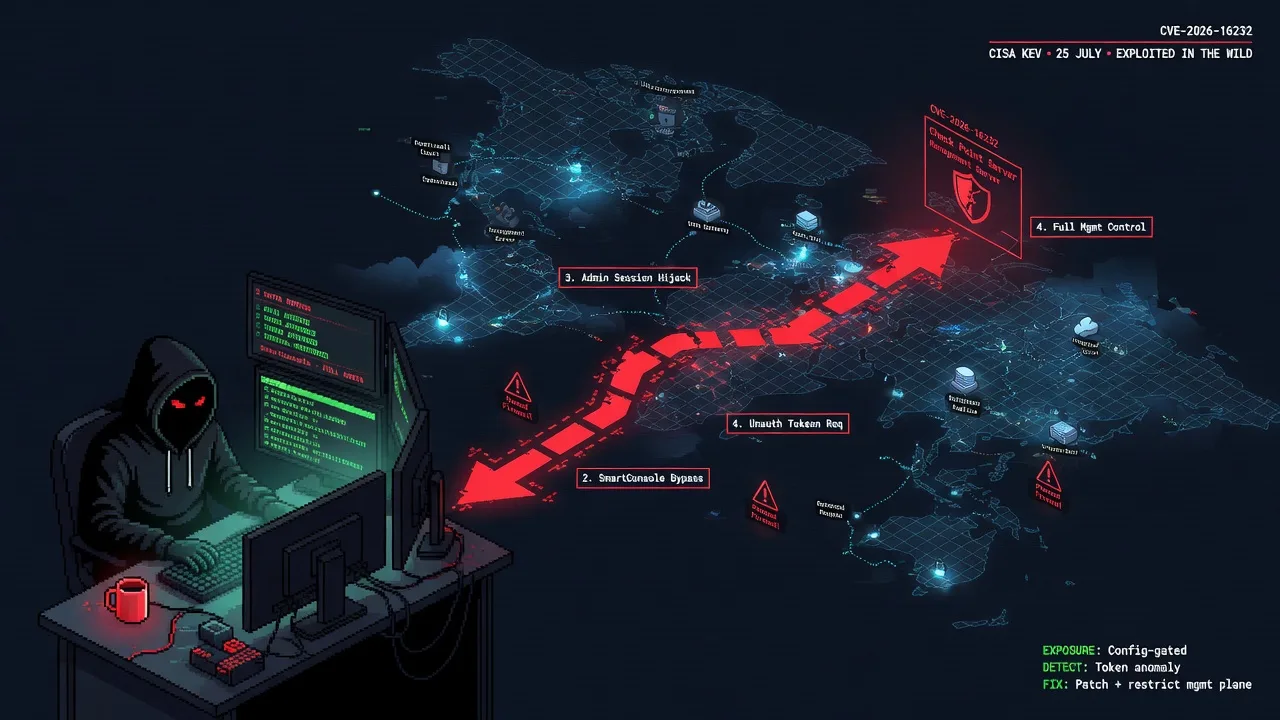
Check Point is patching an actively-exploited zero-day in its SmartConsole login process: CVE-2026-16232 lets an unauthenticated, remote attacker grab an application login token and log in with full administrator privileges on the Check Point Management Server — the box that stores and pushes policy to every managed firewall. CISA added it to the Known Exploited Vulnerabilities catalog on 22 July 2026 with a remediation deadline of 25 July 2026.
Scores as of 2026-07-25live record →
What the flaw actually is
The bug is an authentication bypass (CWE-287) in the SmartConsole login flow on the Security Management Server (SMS) and Multi-Domain Security Management (MDS). Per Check Point, an unauthenticated attacker can obtain an application login token and use it to authenticate as a full admin, then rewrite security policy, change administrator permissions, tamper with VPN configuration, and disable logging.
Two honest caveats. First, this is a management-plane compromise, not a gateway data-plane bug — and that is exactly what makes it dangerous: admin of the manager is transitive control of every firewall it manages. Second, the deep internals are not public. Check Point found the issue during an internal review and disclosed it as a live zero-day; no source explains how the token is obtained at the protocol level, and there is no public proof-of-concept. The one concrete fingerprint the vendor did share is a detection signal — admin logins whose authentication method is application token — which tells you the shape of the bug without handing anyone an exploit.
Am I exposed? The two preconditions
The base CVSS assumes network reach, but real-world exploitability needs both of these — if either is false, the flaw is not remotely exploitable:
- The Management Server IP is reachable from the attacker — internet-exposed, or reachable from a low-trust segment (management/control ports such as 19009, legacy 18190, and 443).
- Trusted Clients is unrestricted — the SmartConsole GUI-client allowlist left as Type "Any" (
0.0.0.0/0). Check Point: "This only affects a very specific configuration — when Management is exposed directly to the internet without IP restrictions."
The exploitation chain
Read left-to-right, the attack is short: find an exposed manager, confirm the allowlist is open, bypass auth to mint an admin token, and then operate as a trusted administrator. The green branch is the cheapest place to break it — restricting Trusted Clients removes a precondition and stops the chain even before you patch. The amber nodes are where a defender can see it, because a bypass that ends in a valid admin session is caught by audit-log anomaly, not by an IPS signature.
CVE-2026-16232 — SmartConsole auth-bypass kill chain (with prevent/detect chokepoints)
- CVE-2026-16232 · KEV due 2026-07-25 — Actively exploited zero-day. Full admin on the Check Point Management Server.
- Recon: internet-reachable SMS/MDS — Attacker finds a Management Server exposed to untrusted networks. **Precondition #1.**
- Trusted Clients = 'Any'? — Exploitation also needs the SmartConsole allowlist unrestricted. Restricted → chain stops. **Precondition #2.**
- Restrict Trusted Clients + firewall mgmt — Specific IPs (never 'Any') + firewalled manager removes precondition #2 — neutralises the attack even unpatched.
- Obtain application login token — Unauthenticated attacker obtains an application login token via the flawed login path (CWE-287).
- Log in as full admin — Token replayed → full administrative privileges on the SMS/MDS. ATT&CK T1190 → T1078.
- Detect: 'application token' admin login — Hunt the audit log for `Authentication method: application token` from unexpected IPs + the six attacker IPs.
- Rewrite policy · add admins · tamper logs/VPN — Admin of the manager = control of every managed gateway. Alter admins (T1098), impair logging (T1562).
- Detect: new admins / policy install / TC change — Correlate an anomalous token login with new admins, permission changes, Install Policy, Trusted Clients edits.
- Estate-wide impact — Compromise propagates to all managed firewalls. Patching does not evict an in-place admin — assume breach.
Affected versions and the fix
The bug spans a wide range of management versions, but Check Point only ships fixed builds for the supported trains via Jumbo Hotfix Accumulators released on 22 July 2026. Take numbers are vendor-stated in sk185169 — verify in the authenticated advisory before change control.
| Train | Status | Fixed in |
|---|---|---|
| R82.10 | Affected | Jumbo Hotfix Accumulator Take 36 and later |
| R82 | Affected | Jumbo Hotfix Accumulator Take 118 and later |
| R81.20 | Affected | Jumbo Hotfix Accumulator Take 158 and later |
| R81.10, R81, R80.x, R77.30 | Affected, end-of-support | No fixed take — upgrade to a supported train, then apply the Jumbo |
Disclosure → exploitation timeline
How this unfolded
- Advisory sk185169 first publishedPage metadata suggests an initial publication; treat as approximate.
- Public advisory + Jumbo Hotfixes releasedCheck Point discloses the flaw was found in an internal review and already exploited in the wild against a small number of customers.
- Added to CISA KEVRemediation due 2026-07-25 — a three-day window.
- Press coverageBleepingComputer, The Hacker News, Help Net Security, Rapid7, SecurityWeek.
- CISA federal remediation deadlineKEV due date for CVE-2026-16232.
Detection and hunting
Because the outcome is a legitimate admin session, hunting is anomaly detection, not signature matching. The primary signal: in the SmartConsole Audit Log View, look for successful administrator logins where Authentication method = application token, especially from unexpected source IPs. Check Point also published attacker IP indicators — hunt these in audit and connection logs ($FWDIR/log/*.adtlog, cpm.elg, or your SIEM if Log Exporter is deployed):
| Published attacker IPs (IoCs) |
|---|
| 151.241.99.207 |
| 151.241.99.233 |
| 158.62.198.182 |
| 192.142.10.99 |
| 139.28.37.250 |
| 194.213.18.137 |
Sources differ on the count — five IPs appear in some extracts, six in others (the extra is 194.213.18.137); treat all six as in scope. Critically, Check Point warns that the absence of these IPs does not confirm you were unaffected. Correlate any anomalous token login with the same session's new-administrator objects, permission-profile changes, Install Policy events, and Trusted Clients edits. No vendor Sigma rule ships, so the two below are author-written heuristics — validate the field names against your Check Point Log Exporter mapping before deploying.
Rule 1 is behavioural and survives IP rotation; Rule 2 is high-fidelity but decays as infrastructure changes. Deploy both.
title: Check Point SmartConsole Admin Auth via Application Token (CVE-2026-16232)
id: 8f2c1a90-16e2-4b32-9d21-cve202616232a
status: experimental
description: Admin authentication to a Check Point Management Server using an application
  token, the auth path abused by CVE-2026-16232. Proposed heuristic; map fields to your parser.
references:
  - https://support.checkpoint.com/results/sk/sk185169/
logsource:
  product: checkpoint
  service: audit
detection:
  selection_token:
    auth_method|contains: 'application token'
    operation|contains: 'Log In'
  filter_trusted:
    src_ip|cidr:
      - '10.0.0.0/8'
      - '172.16.0.0/12'
      - '192.168.0.0/16'
  condition: selection_token and not filter_trusted
fields: [src_ip, administrator, auth_method, operation]
falsepositives:
  - Legitimate API/automation using application tokens from non-RFC1918 egress
level: hightitle: Check Point Management Activity from CVE-2026-16232 Attacker IPs
id: 8f2c1a90-16e2-4b32-9d21-cve202616232b
status: experimental
description: Flags any Check Point management/audit event whose source IP matches the
Check Point-published CVE-2026-16232 attacker IoCs (point-in-time; absence != safety).
logsource:
product: checkpoint
detection:
selection_ioc:
src_ip:
- '151.241.99.207'
- '151.241.99.233'
- '158.62.198.182'
- '192.142.10.99'
- '139.28.37.250'
- '194.213.18.137'
condition: selection_ioc
fields: [src_ip, dst_ip, administrator, operation]
level: criticalFix it: the playbook
- Mitigate now (minutes). In SmartConsole → Manage & Settings → Permissions & Administrators → Trusted Clients, set each entry's Type to a specific IP/network — never "Any". Firewall the manager to trusted source IPs and enable implied rules for control connections. This removes a precondition and neutralises the attack even unpatched — but it is not a substitute for the fix.
- Patch (same day). Install the Jumbo Hotfix Accumulator via CPUSE (R82.10 Take 36+, R82 Take 118+, R81.20 Take 158+), meet or exceed the take, and reboot. End-of-support trains: upgrade first. Bundle CVE-2026-62144 and CVE-2026-62145.
- Assume breach if you were exposed. A live zero-day means patching may be too late — it does not evict an admin who already got in. Run the hunt above, rotate administrator credentials and API keys, review policy and VPN config for tampering, and only then restore trust in the manager.
Is CVE-2026-16232 being exploited?
Is there a public exploit or PoC?
Am I affected if my Management Server isn't internet-facing?
Does restricting Trusted Clients replace the patch?
Was the Qilin ransomware group behind this?
Sources
- Check Point — Security advisory sk185169
- Check Point blog — Active exploitation of SmartConsole authentication bypass (CVE-2026-16232)
- CISA — Adds CVE-2026-16232 to the Known Exploited Vulnerabilities catalog
- Rapid7 — Emergency threat response: CVE-2026-16232
- BleepingComputer — Check Point patches SmartConsole zero-day exploited in attacks
- The Hacker News — Check Point patches exploited SmartConsole flaw
- Help Net Security — Check Point vulnerability CVE-2026-16232
- SecurityWeek — New Check Point zero-day vulnerability exploited in the wild
- Tenable — CVE-2026-16232