
The Fallback Secret That Turned JFrog Artifactory Into an Admin Vending Machine
CVE-2026-82329 doesn't need a password, a token, or a bug in the traditional sense — just an Artifactory instance that skipped one manual configuration step. CISA gave it a KEV listing four days after the patch shipped.
On August 28, 2026, JFrog shipped a patch for a critical bug in Artifactory — the repository manager that sits at the center of software supply chains for CI/CD pipelines, package registries, and build systems. By September 1, watchTowr's honeypot network was already logging attackers exploiting it in the wild. On September 2, CISA added it to the Known Exploited Vulnerabilities catalog with a three-day federal remediation deadline.
The bug isn't a bug — it's a default
CVE-2026-82329 is filed as CWE-287, improper authentication. JFrog's own advisory is unusually sparse: "JFrog Artifactory contains an authentication weakness that, under default configuration, may allow an unauthenticated attacker with network access to obtain administrative privileges." JFrog's CTO, Yoav Landman, clarified on X that the flaw is "improper authentication rather than RCE," and that it does not affect JFrog's own SaaS/Cloud platform — only self-hosted deployments.
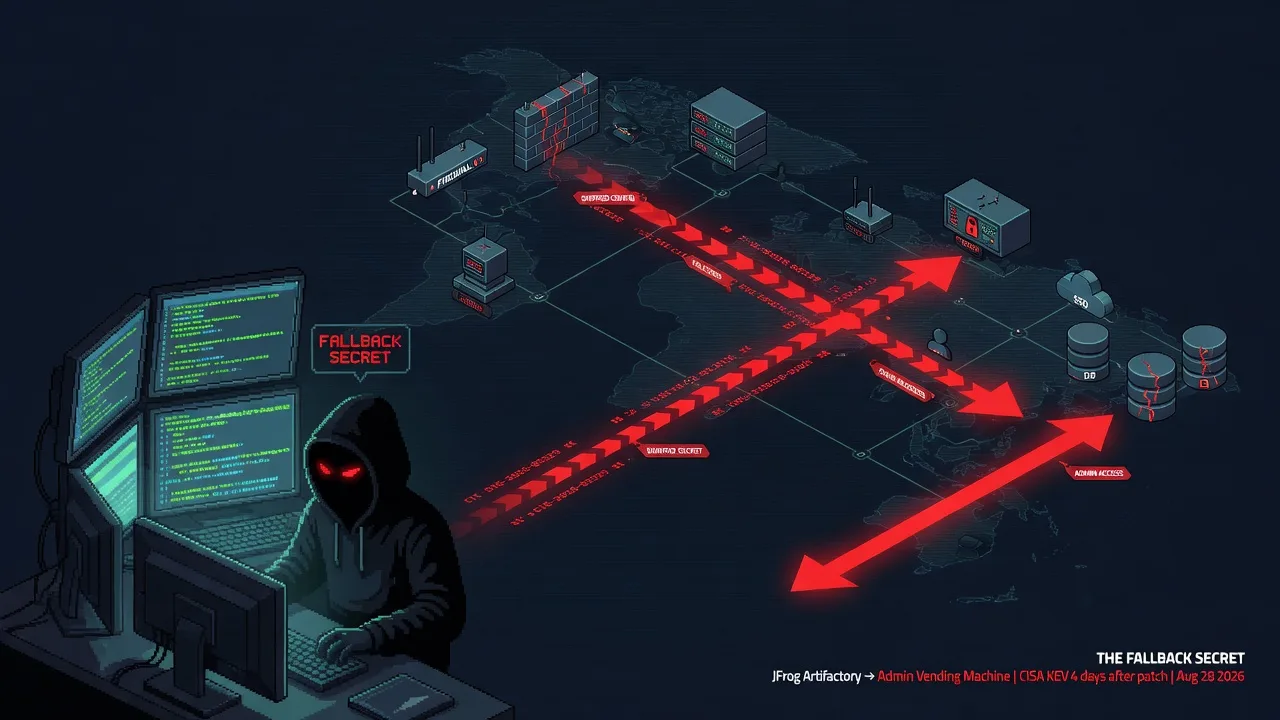
The mechanism, as watchTowr's principal threat intelligence specialist Yordan Ganchev explained to The Hacker News, comes down to how Artifactory nodes trust each other. Artifactory instances federate using a join key — a shared secret that lets servers recognize one another as legitimate parts of the same cluster. If an administrator never manually sets that secret, Artifactory doesn't refuse to start or throw a warning. It silently generates a fallback "phantom" join key on its own. An attacker who understands how that phantom key is derived can forge the trust relationship it's meant to protect, and mint themselves a fully valid administrator token — indistinguishable, on inspection, from one issued to a real admin.
What CISA's KEV catalog and the vendor advisory each get you
JFrog's advisory vs. what researchers found
- Confirms the flaw exists under default configuration
- Confirms it's unauthenticated, network-reachable
- Names the fixed versions per branch
- Confirms Cloud/SaaS was never affected
- Does not explain the join-key mechanism
- Does not mention active exploitation
- Named the phantom join-key root cause
- Observed live exploitation via honeypots starting Sept 1
- Documented attackers minting admin tokens and enumerating users, groups, and federated access
- Confirmed backdoor-user creation in a subset of attacks
- CISA KEV listing forces a hard federal deadline
- Neither source published IOCs or attacker attribution
What we watched attackers actually do
Four days, disclosure to KEV
- JFrog patches CVE-2026-82329Fixed versions released across six branches: 7.111.21, 7.117.28, 7.125.20, 7.133.29, 7.146.38, 7.161.20. No workaround exists besides upgrading.
- watchTowr observes active exploitationAttacker Eye honeypot network logs attackers minting admin tokens, then enumerating users, groups, credential sets, and federated access topologies from a small number of IPs across varying geographies.
- Backdoor users created in some attacksIn a limited number of observed intrusions, attackers went beyond token minting to create new admin-level user accounts — a persistence path that survives a version upgrade.
- CISA adds CVE-2026-82329 to KEVFederal deadline set for Sep 5, 2026 under Binding Operational Directive 26-04 — part of a seven-CVE batch that also included SonicWall SMA1000, Sangoma Switchvox, Kestra OSS, and Berri LiteLLM.
Why admin-on-Artifactory is worse than admin-on-most-things
Artifactory isn't a website — it's the thing that hands trusted, signed build artifacts to every downstream system that consumes them. Ganchev put it plainly to DailyCVE: attackers with admin access can "build, ship and distribute software fast" using the platform's own legitimate mechanisms. Black Duck's Collin Hogue-Spears framed the deeper problem: "A signature stored beside an artifact is evidence. A signature checked at deployment time is enforcement." Admin access to Artifactory can compromise the evidence — replacing a legitimate build with a malicious one, tampering with build pipelines, or pushing a poisoned package downstream to every consumer who trusts the registry.
| CVE | What it is | CVSS | In KEV | Public exploit code |
|---|---|---|---|---|
| CVE-2026-82329 | Unauthenticated auth bypass to admin (phantom join key) | 9.8 | Yes — Sep 2, 2026 | None indexed |
| CVE-2026-66384 | Authenticated user writes outside intended Docker cache path | 5.3 | Yes — Aug 27, 2026 | None indexed |
That second row matters for context, not alarm: CVE-2026-66384 is a much lower-severity, authenticated-only path-traversal-style bug in Artifactory's Docker remote-repository caching, added to KEV a day earlier. It's a reminder that Artifactory has drawn more than one KEV entry in the same two-week window — but it needs a valid account first, which is a fundamentally different risk than CVE-2026-82329's zero-credential path to full admin.
Our own data hasn't caught up — and that's normal here
As of this writing, our index lists CVE-2026-82329 with has_exploit: false and an EPSS score of 7.7% (94th percentile) — both technically accurate against public exploit-code trackers and the EPSS model's training data, and both understating what watchTowr's honeypots were already logging. No public proof-of-concept has been published; the trigger was reverse-engineered from a patch diff and confirmed independently by a commercial threat-intel vendor with its own sensor network, which most automated exploit-tracking sources don't see. If your only signal is EPSS or a public-PoC flag, this is exactly the kind of bug that reads as lower priority than it is.
CVE data as of 2026-09-07
If you run self-hosted Artifactory
- Upgrade to the fixed version for your branch (7.111.21, 7.117.28, 7.125.20, 7.133.29, 7.146.38, or 7.161.20) — there is no workaround short of patching.
- Explicitly configure the Artifactory join key rather than leaving it unset, so no phantom key is ever generated on restart.
- Audit every access token — expiring and non-expiring — issued before the patch, and revoke anything you don't recognize.
- Review the admin/user list for accounts you didn't create; a subset of observed attacks planted backdoor admin users.
- Check build-pipeline and repository integrity for artifacts modified during your exposure window, especially if internet-facing.