
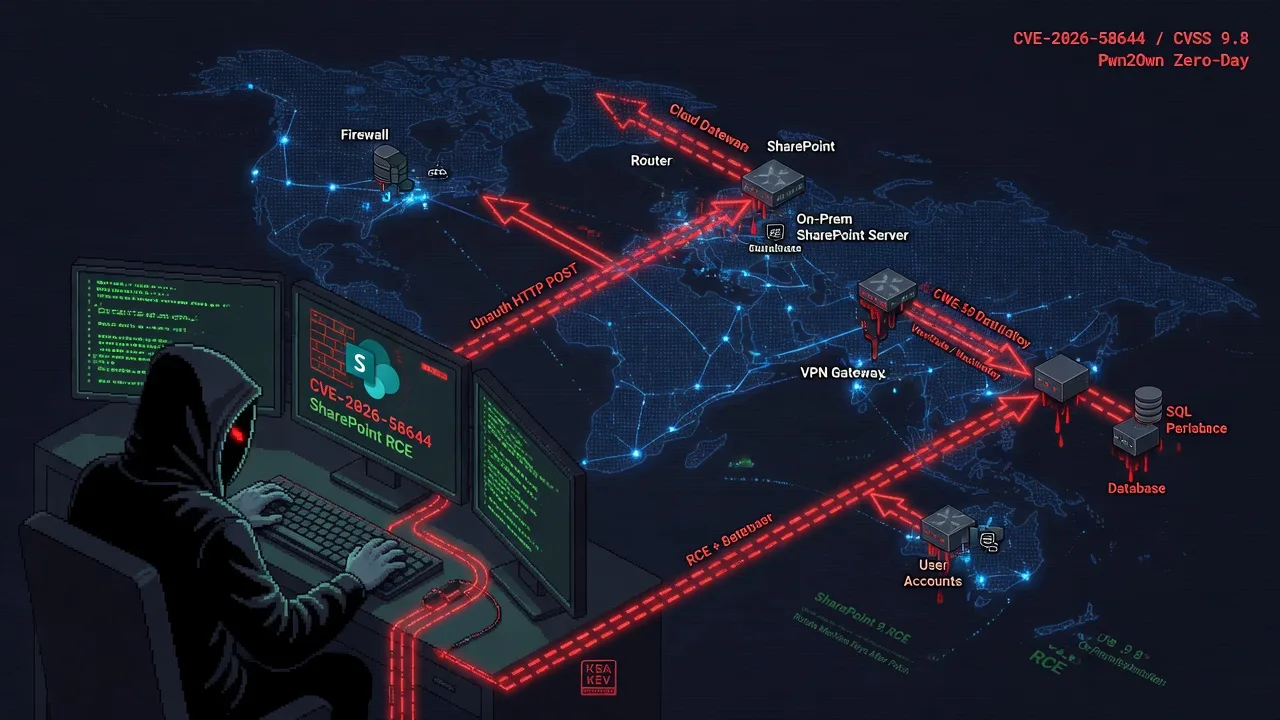
SharePoint's next 9.8: an unauthenticated RCE that was exploited before the patch shipped (CVE-2026-58644)
A CWE-502 deserialization bug, demonstrated at Pwn2Own and used as a zero-day - and why patching it isn't the same as remediating it.
CVE Tools11 min read
Microsoft's July 2026 Patch Tuesday was its largest ever, and buried in it was a SharePoint bug that ticks every box you don't want ticked at once: unauthenticated, remote, code execution, and already being used in real attacks. By the numbers it is a 9.8. In practice the number almost undersells it - because the exploit was demonstrated at Pwn2Own before Microsoft ever shipped a patch, and because this class of SharePoint bug has a persistence trick that survives the patch you're about to install.
Scores as of 2026-07-18live record →
What the flaw actually is
The weakness is deserialization of untrusted data (CWE-502). Microsoft's own description is blunt: "Deserialization of untrusted data in Microsoft Office SharePoint allows an unauthorized attacker to execute code over a network." In plain terms, attacker-controlled bytes reach a .NET deserializer, and a crafted serialized object graph turns into code running inside the SharePoint IIS worker process. Affected products are the on-prem editions - SharePoint Enterprise Server 2016, SharePoint Server 2019, and Subscription Edition. SharePoint Online in Microsoft 365 is not affected.
One honest caveat: four days after disclosure, Microsoft has not published the exact vulnerable endpoint, and no public technical write-up describes the specific sink. What is well documented is the lineage. The 2025 SharePoint "ToolShell" wave abused the same __VIEWSTATE / machine-key deserialization surface - stealing ASP.NET keys and forging signed payloads that deserialize into code. Because the new bug is the same product family and the same bug class, that mechanism is the plausible route. Whether it is a direct variant of the 2025 chain is unconfirmed, so treat the ToolShell mechanics below as the attributed pattern, not a proven description of this specific flaw.
Why a bug no one has PoC'd is still an emergency
You may notice the EPSS score is low - around 0.015, roughly the 70th percentile - and wonder how a 9.8 with a low EPSS can be urgent. The answer is that EPSS and KEV measure different things. EPSS is a statistical model driven by observable signals: public exploit code, scanner chatter, mass-scanning telemetry. For a brand-new bug with no public PoC, those inputs are mostly absent, so the score stays low and will jump the moment code appears. KEV, by contrast, is CISA saying it has confirmed evidence of exploitation in the wild. When the two disagree, KEV wins.
And the "no public PoC" reassurance is thin here. A functional exploit demonstrably exists: this bug and its twin CVE-2026-50522 are a matching pair of CVSS 9.8 SharePoint deserialization bugs shown at Pwn2Own Berlin, where ZDI handed Microsoft working code. ZDI publicly criticised Microsoft's "Exploit Maturity: Unknown" label for exactly that reason. The exploit is real; it just isn't on GitHub yet.
| Signal | Value | What it tells you |
|---|---|---|
| CVSS base | 9.8 (Critical) | Network, no privileges, no user interaction (NVD/MSRC record) |
| Authentication | None required (disputed) | NVD/ZDI say unauth; some press paraphrase 'Site Owner' - verify |
| CISA KEV | Added 2026-07-16, due 2026-07-19 | Confirmed exploited; 3-day BOD 26-04 clock |
| EPSS | ~0.015 (70th pct) | Low only because no public PoC yet - not a safety signal |
| Public PoC | None yet - working exploit exists privately | Demonstrated at Pwn2Own Berlin; ZDI gave Microsoft the code |
| Fix | July 14, 2026 Patch Tuesday | Patch AND rotate machine keys - patching alone is not enough |
The exploitation chain
Here is the path from an exposed farm to persistent code execution, with the points where a defender can break the chain. The attacker's route runs down the middle; the green branches on the right are your chokepoints. Note the last one - rotating machine keys - because it is the step that actually evicts an intruder the patch leaves behind.
CVE-2026-58644 - unauthenticated SharePoint deserialization RCE, with defender chokepoints
- Unauth deserialization RCE (CWE-502) - CVSS 9.8, KEV zero-day — An untrusted-deserialization sink reachable over the network. Starting point: an attacker who can reach an on-prem SharePoint farm.
- Find internet-facing on-prem SharePoint — Enumerate exposed 2016/2019/Subscription-Edition farms via Shodan `http.component:sharepoint` or the `MicrosoftSharePointTeamServices` build header. SharePoint Online is not affected.
- Send crafted request -> untrusted deserialization — A malicious .NET object graph reaches the deserializer. Per the scored CVSS vector, no authentication is required. Exact endpoint not yet disclosed by Microsoft.
- Code runs as w3wp.exe (SharePoint IIS worker) — Full remote code execution in the SharePoint app-pool context - the core impact of the bug.
- Persist beyond the patch? — The attacker can stop at RCE, or dig in so that patching won't remove them.
- Web shell + steal ASP.NET MachineKeys -> forge __VIEWSTATE — Drop an .aspx web shell in the LAYOUTS directory and steal ValidationKey/DecryptionKey. Forged, signed __VIEWSTATE payloads keep deserializing to RCE even after the patch.
- Defender: patch to the fixed build — Installing the July-2026 build (and running PSConfig) closes the injection route.
- Defender: AMSI Full Mode + w3wp->shell detection — AMSI request-body scanning blunts exploitation; alert on the SharePoint worker spawning cmd/powershell/csc - it almost never does that legitimately.
- Defender: rotate MachineKeys + hunt — Rotate ASP.NET machine keys on every farm server and iisreset - this is what evicts an attacker who already stole your keys. Hunt first so you don't rotate around a live intruder.
- Patched, key-rotated, verified farm — Injection route closed AND stolen keys invalidated AND the estate hunted clean.
Am I affected?
Read your farm build with (Get-SPFarm).BuildVersion and compare it to the fixed build for your edition. The build numbers below are confirmed against NVD; the KB article strings reported in secondary coverage (KB5002653/54/55) could not be confirmed on a primary Microsoft page, so verify those against the MSRC Security Update Guide before you cite them in a change ticket. After installing binaries, run PSConfig - a farm can report the new build while the fix isn't actually wired in.
| Edition | Affected | Fixed build (install this or later) |
|---|---|---|
| SharePoint Enterprise Server 2016 | below 16.0.5556.1005 | 16.0.5556.1005 |
| SharePoint Server 2019 | below 16.0.10417.20153 | 16.0.10417.20153 |
| SharePoint Server Subscription Edition | below 16.0.19725.20384 | 16.0.19725.20384 |
| SharePoint Online (Microsoft 365) | Not affected | - |
Exploited before the patch - and part of a bigger wave
This bug didn't arrive alone. It sits inside a July 2026 on-prem SharePoint cluster that CISA flagged together (CVE-2026-32201, CVE-2026-45659, CVE-2026-56164 and this one), and it shares a bloodline with the 2025 ToolShell mass exploitation. VulnCheck characterised current activity as targeted rather than a broad campaign - but with a public exploit's plumbing already proven, that can change quickly. Shadowserver tracks roughly 10,000 internet-exposed on-prem SharePoint servers overall, which is the pool at risk across the whole cluster.
From Pwn2Own to a 3-day federal deadline
- Demonstrated at Pwn2Own BerlinZDI shows the deserialization pair (this bug + CVE-2026-50522) and hands Microsoft working exploit code. Date approximate to the contest window.source
- Fix ships in the July Patch TuesdayBundled into Microsoft's largest-ever update (~570-622 CVEs), initially rated 'Exploitation More Likely'. VulnCheck noted it looked slated for June and slipped a cycle.source
- Microsoft revises to 'Exploitation Detected'The advisory is updated to confirm in-the-wild zero-day use around patch availability.source
- Added to CISA KEVCISA lists the bug as known-exploited and sets a BOD 26-04 remediation deadline three days out.source
- Federal remediation deadlineFCEB agencies must remediate; everyone else should treat it as emergency change.source
Detection & hunting
There are no bug-specific indicators to key on yet, so hunt on behaviour, not on 2025's filenames and IP addresses (those are almost certainly stale for a new campaign). The 2025 ToolShell detection corpus - SigmaHQ rules for CVE-2025-53770 and the Neo23x0 YARA set - transfers well at the behavioural level; just broaden the campaign-specific literals before you deploy it.
- SharePoint worker spawning a shell -
w3wp.exelaunchingcmd.exe,powershell.exe, orcsc.exe. The app pool almost never does this legitimately; it's your highest-fidelity signal. - New
.aspxin the LAYOUTS directory - anything written under...\Microsoft Shared\Web Server Extensions\1[56]\TEMPLATE\LAYOUTS\. - Machine-key theft - PowerShell under
w3wp.exereadingValidationKey/DecryptionKeyfromweb.config; Defender/AMSI hits likeTrojan:PowerShell/MachineKeyFinder.DA!amsi. - Adapt, don't copy the 2025 rules (SigmaHQ CVE-2025-53770, Neo23x0 signature-base) - keep the behaviour, relax the filenames/hashes.
What to do now
- Patch every farm to the July-2026 fixed build for its edition, then run PSConfig.
- Enable AMSI Full Mode (Request Body Scan = Full) and confirm Defender/EDR is running on every SharePoint server.
- If it was internet-facing since ~July 14, assume compromise - hunt and remove web shells / machine-key harvesters (and any malicious
applicationHost.config/web.configmodule entries) first. - Rotate ASP.NET machine keys on all farm servers (
Update-SPMachineKey; confirm the exact cmdlet for your build), theniisresetso the new keys load. - Patch the rest of the July-2026 SharePoint cluster in the same window - CVE-2026-32201, CVE-2026-45659, CVE-2026-56164 and the twin CVE-2026-50522.
- Verify estate-wide, and fold in an EoL migration plan for anything you can't keep patched.
FAQ
Is CVE-2026-58644 being exploited?
Do I need credentials to exploit it?
Is patching enough?
Is SharePoint Online affected?
Why is EPSS so low for a 9.8?
Sources
- NVD - CVE-2026-58644
- Microsoft MSRC advisory
- CISA Known Exploited Vulnerabilities catalog
- Zero Day Initiative - The July 2026 Security Update Review
- The Hacker News - CISA adds exploited SharePoint RCE zero-day
- SecurityWeek - Fresh SharePoint vulnerability exploited soon after disclosure
- Cybersecurity Dive - CISA warns of multiple exploited SharePoint flaws
- Microsoft - Disrupting active exploitation of on-premises SharePoint (2025 lineage + guidance)
- SigmaHQ - CVE-2025-53770 detection rules