
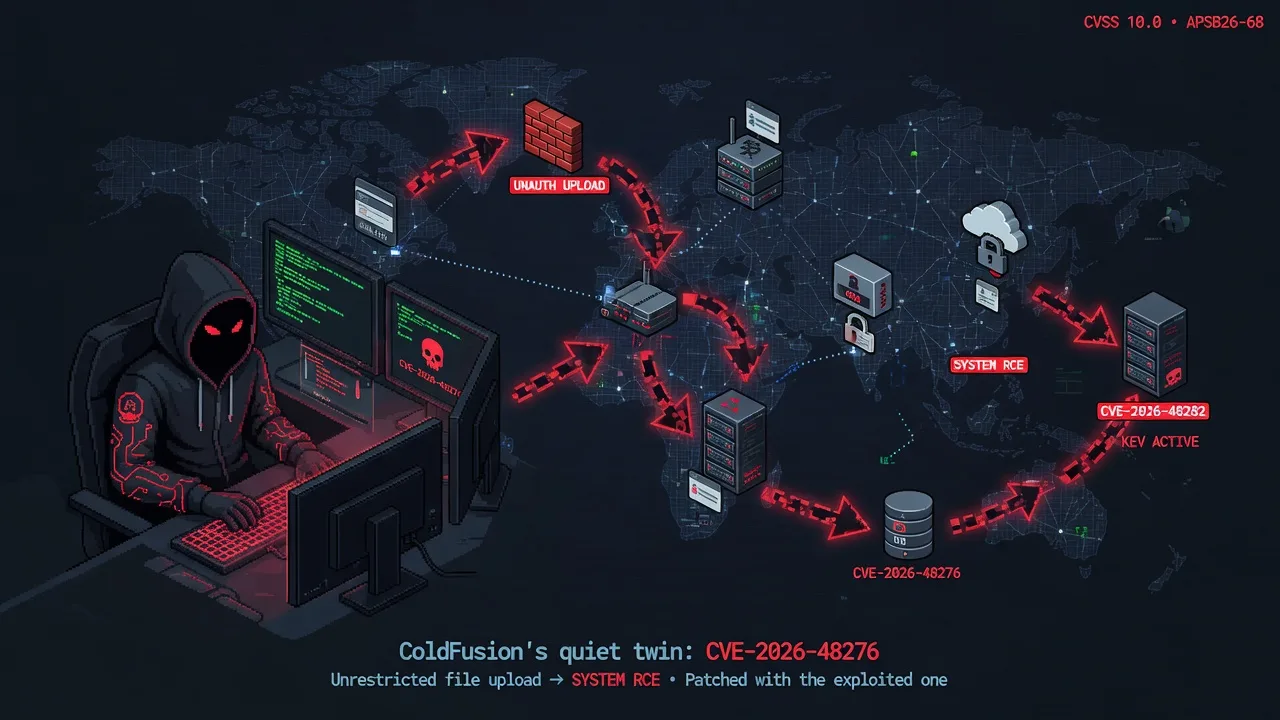
ColdFusion's quiet twin: the CVSS-10 file-upload RCE hiding behind the one everyone's patching (CVE-2026-48276)
A CWE-434 unrestricted upload that ends in SYSTEM-level RCE - unweaponised, but co-fixed with the actively-exploited CVE-2026-48282. Patch one and you close both.
CVE Tools14 min read
Every big vendor bulletin has a headline bug. Adobe's APSB26-68 had CVE-2026-48282 — a ColdFusion path-traversal that was exploited within about two hours of the technical write-up going public and landed on CISA's KEV list days later. But it had a twin. Buried in the same update is a second, structurally different max-severity flaw that ends in exactly the same place: an attacker-uploaded file running as the ColdFusion service account. It has no public proof-of-concept, no Nuclei template, and no honeypot hits — yet. This is the quiet one, and the reason it matters is that most teams will fix the loud one and never realise they closed this too — or, worse, mitigate the loud one a way that leaves this open.
Scores as of 2026-07-18live record →
What the flaw actually is
At its core the bug is a missing check. A ColdFusion upload handler accepts a file without properly validating its type, then stores it somewhere ColdFusion will later execute. Hand it a file with an executable ColdFusion extension — a .cfm or .cfc, or a servlet-executable .jsp — and it lands in a web-served directory as a live web shell. Adobe classifies it as CWE-434, Unrestricted Upload of File with Dangerous Type, and the scored vector is CVSS:3.1/AV:N/AC:L/PR:N/UI:N/S:C/C:H/I:H/A:H — a clean 10.0, reachable over the network with no login and no user interaction (NVD, CCB Belgium). The Scope: Changed flag is there because ColdFusion typically runs as a highly privileged account, so code lands as NT AUTHORITY\SYSTEM on Windows or root on Linux.
Where exactly is the vulnerable handler? Here the honest answer is probably, but not confirmed. Adobe's advisory names no endpoint. The most detailed public analysis, from watchTowr Labs, tentatively pins it on the CKEditor filemanager upload component (/cf_scripts/scripts/ajax/ckeditor/plugins/filemanager/upload.cfm), reachable without authentication once file uploads are enabled — but the researchers explicitly file it under "CVE-2026-48276 (maybe)" and warn that matching individual CVE IDs to bugs across this 11-CVE bulletin is unreliable (watchTowr). Treat the endpoint as a strong hint for hunting, not gospel. Notably, it is the same CKEditor filemanager plugin family that was abused in 2023's CVE-2023-26360 to breach a US federal agency.
The quiet twin: CVE-2026-48276 vs the KEV'd CVE-2026-48282
These are two different bugs that reach the same outcome. One writes a file through a path traversal in the RDS FILEIO endpoint; the other writes a file by simply not checking what you uploaded. Both end in a web shell running as the service account. The only real difference today is how much noise each is making — and that gap is exactly where teams get caught.
Two CVSS-10 ColdFusion RCEs, one bulletin, one fix
| CVE-2026-48276 — the quiet twin | CVE-2026-48282 — the loud one | |
|---|---|---|
| Bug class | Unrestricted file upload (CWE-434) | RDS FILEIO path traversal (CWE-22) |
| CVSS | 10.0 — unauth RCE | 10.0 — unauth RCE |
| On CISA KEV? | No (as of 2026-07-18) | Yes — added 2026-07-07, due 2026-07-10 |
| Public PoC / Nuclei | None found | Public Python tool + verified Nuclei template |
| In-the-wild | None reported | Exploited ~2h after disclosure |
| Fixed by | ColdFusion 2025 U10 / 2023 U21 | Same update — 2025 U10 / 2023 U21 |
| End state | Web shell as service account (SYSTEM/root) | Web shell as service account (SYSTEM/root) |
From an upload to SYSTEM: the chain
The chain is short and entirely mechanical, which is what makes an unauthenticated CVSS-10 upload bug so dangerous. An attacker sends a multipart POST carrying an executable ColdFusion or JSP payload; the handler writes it into a web-served directory because it never rejected the dangerous type; the attacker then requests that file over HTTP, and ColdFusion compiles and runs it — spawning commands via <cfexecute>, a Java Runtime.exec call, or a <cfhttp>/<cffile> downloader. From there it is a web shell with the privileges of the ColdFusion service. The chokepoints a defender actually controls are the perimeter (block the filemanager path), the config (don't leave uploads enabled), the patch (kills the write), and least-privilege (so a shell isn't automatically SYSTEM).
CVE-2026-48276 — unauthenticated ColdFusion upload to RCE, with defender chokepoints
- Unrestricted file upload (CWE-434) — CVSS 10, co-fixed with KEV'd 48282 — An upload handler that doesn't validate file type. Starting point: an attacker who can reach an internet-facing ColdFusion instance.
- Recon: find ColdFusion — Fingerprint via `/CFIDE/administrator/`, `/cf_scripts/scripts/`, version banners. **Chokepoint:** block these paths from untrusted networks at the perimeter.
- Reach the upload handler — The suspected surface is the CKEditor filemanager upload endpoint, unauthenticated where uploads are enabled. Attribution is watchTowr's tentative 'maybe'.
- File uploads enabled? — The suspected precondition (reported off by default). If an app enabled uploads, the handler is reachable. **Chokepoint:** disable uploads / lock down the filemanager.
- Write a .cfm/.jsp to the web root — Missing type validation lets an executable file land in a web-served directory. **Chokepoint:** the APSB26-68 patch adds an extension blocklist + traversal guard here.
- GET the dropped shell — ColdFusion compiles & runs it — A request to the uploaded file triggers execution. **Detection chokepoint:** an unauth POST to the filemanager followed by a GET-200 to a new .cfm is the tell-tale pair.
- RCE as the ColdFusion service account (SYSTEM/root) — Code runs with the service's privileges — why CVSS scope is Changed. **Chokepoint:** run ColdFusion least-privilege (Adobe Lockdown Guide) to blunt the impact.
- Post-exploitation — Web-shell persistence, second-stage tool transfer (e.g. certutil), recon, lateral movement — mirroring the CVE-2023-26360 playbook.
- Prevent: apply APSB26-68 — ColdFusion 2025 Update 10 / 2023 Update 21 removes the vulnerable behaviour — and closes the co-fixed CVE-2026-48282 at the same time.
Am I affected?
If you run on-prem Adobe ColdFusion below the fixed builds, yes. The exposure that matters most is an internet-facing instance where an application has file uploads enabled — but because the same update also fixes the actively-exploited path-traversal twin, the practical answer for any unpatched ColdFusion is "patch on the emergency track."
| ColdFusion train | Vulnerable | Fixed build |
|---|---|---|
| ColdFusion 2025 | Update 9 (2025.9) and earlier | 2025 Update 10 |
| ColdFusion 2023 | Update 20 (2023.20) and earlier | 2023 Update 21 |
| ColdFusion 2021 | All (End-of-Life) | No fix — migrate/retire |
How urgent is it, really?
Taken alone, the signals look calm: not on KEV, and an EPSS score under one percent. Do not read that as an all-clear. EPSS measures observed exploitation of this specific ID, and a brand-new bug with no public exploit and a config gate is expected to score low — it is a statement about today, not about the ceiling. The impact ceiling is a perfect 10: unauthenticated, SYSTEM-level code execution. And ColdFusion's history is brutal — the same class of bug breached a federal agency in 2023, and a broker-style campaign has been farming ColdFusion at scale. Use "not KEV, low EPSS" to rank this within the patch wave, not to carve it out of it. If a public PoC lands, its risk profile snaps to its twin's overnight.
| Signal | Value | What it tells you |
|---|---|---|
| CVSS base | 10.0 (Critical) | Network, no auth, no user interaction; Scope: Changed |
| CISA KEV | Not listed (as of 2026-07-18) | No confirmed exploitation of this ID — unlike the twin 48282 |
| EPSS | ~0.9% (~56th pct) | Low only because there's no public PoC yet — not a safety signal |
| Public PoC / Nuclei | None found (2026-07-18) | Sharp gap vs 48282, which has both — but the mechanism is public |
| Fix | APSB26-68 (2026-06-30) | 2025 Update 10 / 2023 Update 21 — also fixes the KEV'd twin |
How it unfolded
The two twins were born the same day. One was weaponised almost immediately; the other has stayed dormant.
APSB26-68: one bulletin, two very different weeks
- Adobe ships APSB26-68~11 ColdFusion CVEs, several rated CVSS 10.0. Both CVE-2026-48276 and CVE-2026-48282 are published to NVD the same day.source
- watchTowr publishes its analysisTechnical write-up of the bulletin; tentatively maps 48276 to the CKEditor filemanager upload and cautions that CVE-to-bug attribution is uncertain.source
- The twin (48282) is exploited in the wildHoneypots capture exploitation of CVE-2026-48282 within ~2 hours of public technical details, from an India-geolocated IP. No activity reported against 48276.source
- CISA adds 48282 to KEV — not 48276CVE-2026-48282 gets a federal remediation deadline of 2026-07-10. CVE-2026-48276 is not added.source
- Analysts separate the twoGreenbone's write-up explicitly distinguishes 48282 (path traversal, exploited) from 48276 (file upload); honeypot activity is on 48282 only.source
- 48276 remains quietStill no CISA KEV listing, no public PoC, and no reported in-the-wild exploitation of the file-upload bug.
Detection and hunting
You are hunting for two things: exposure (unpatched ColdFusion where uploads are reachable) and compromise (a shell that was already dropped). Start by fingerprinting ColdFusion and confirming the applied update level — patched vs vulnerable comes down to the build number.
$ # External fingerprint — is this a ColdFusion box, and what build?$ curl -sI https://HOST/CFIDE/administrator/index.cfm$ curl -s https://HOST/cf_scripts/scripts/ # CKEditor/AJAX assets = the exploit's surface$ # Applied update level (compare to 2025 Update 10 / 2023 Update 21):$ # Administrator console -> System Information$ # CFML at runtime -> server.coldfusion.productversion / productlevel$ # On disk -> /cfusion/hf-updates/hf--/$ # /cfusion/lib/ (jar versions)For compromise, the highest-fidelity signal is the request pair the exploit produces: an unauthenticated POST to the CKEditor filemanager path, immediately followed by a GET (HTTP 200) to a newly-created .cfm/.cfc/.jsp with a short or random name. On disk, hunt for executable files that don't belong in the ColdFusion web root, /CFIDE/, /cf_scripts/, or the Tomcat work/staging directory. The concrete filenames and TTPs from the 2023 CVE-2023-26360 campaign — .cfm shells with <cfexecute>, JSP shells like d.jsp/Connection.jsp, certutil.exe -urlcache downloaders, and w3wp/ColdFusion spawning cmd/powershell — are excellent hunting patterns to reuse here (CISA AA23-339A, Rapid7).
These are generic ColdFusion upload-abuse and web-shell detections, built on documented TTPs (CVE-2023-26360 per CISA AA23-339A / Rapid7; the APSB26-68 upload surface per watchTowr). They are not a CVE-2026-48276 zero-day signature — there is no public PoC — but they fire on the behaviour an exploit of it would produce. Tune field names to your pipeline before production.
title: Suspicious POST to ColdFusion CKEditor FileManager Upload Endpoint
id: 4c2f9a10-7d3e-4b8a-9d21-3e6f0a1c48f0
status: experimental
description: HTTP POST to the ColdFusion CKEditor filemanager upload paths with directory traversal - the attack surface for ColdFusion file-upload RCE (same plugin family as CVE-2023-26360; reported for CVE-2026-48276 / APSB26-68). Generic, not a 48276 0day sig.
tags: [attack.initial_access, attack.t1190, attack.persistence, attack.t1505.003]
logsource:
  category: webserver
detection:
  selection_path:
    cs-method: 'POST'
    c-uri|contains:
      - '/cf_scripts/scripts/ajax/ckeditor/plugins/filemanager/'
      - '/CFIDE/scripts/ajax/ckeditor/plugins/filemanager/'
  selection_traversal:
    c-uri|contains: ['../', '..%2f', '..%5c', '%2e%2e%2f']
  condition: selection_path and selection_traversal
falsepositives:
  - Authenticated developer use of the CKEditor file manager
level: hightitle: Suspicious GET to ColdFusion Executable File in Upload/CFIDE Directories
id: b71e0c94-2a56-4f2d-8c0b-9a2d7e15c3aa
status: experimental
description: Successful GET to .cfm/.cfc/.cfml/.jsp under ColdFusion static/upload dirs that should not host user templates - retrieving a dropped web shell after an upload RCE. Pair with the upload-abuse rule.
tags: [attack.persistence, attack.t1505.003, attack.execution]
logsource:
category: webserver
detection:
selection:
cs-method: 'GET'
sc-status: 200
c-uri|contains:
- '/cf_scripts/scripts/ajax/ckeditor/plugins/filemanager/'
- '/CFIDE/scripts/'
- '/CFIDE/administrator/'
- '/cf_scripts/scripts/'
selection_ext:
c-uri|contains: ['.cfm', '.cfml', '.cfc', '.jsp']
condition: selection and selection_ext
falsepositives:
- Legitimate components under /CFIDE/administrator/ (allowlist known filenames)
level: highrule CFML_ColdFusion_WebShell_Generic
{
meta:
description = "Generic CFML web shells (cfexecute / Java Runtime / cfhttp downloader). Not 48276-specific."
reference = "CISA AA23-339A"
mitre = "T1505.003"
strings:
$cfexecute="rule JSP_ColdFusion_WebShell_Generic
{
meta:
description = "Generic JSP shells dropped via ColdFusion upload RCE (d.jsp/Connection.jsp per CVE-2023-26360). Not 48276-specific."
reference = "CISA AA23-339A"
mitre = "T1505.003"
strings:
$jsp1="<%@ page" nocase
$jsp2="<%"
$exec1="Runtime.getRuntime().exec" nocase
$exec2="ProcessBuilder" nocase
$req="request.getParameter" nocase
$rt="getRuntime" nocase
$io1="getInputStream" nocase
$io2="BufferedReader" nocase
condition:
filesize < 200KB and ($jsp1 or $jsp2) and $req and
(($exec1 or ($exec2 and $rt)) and ($io1 or $io2))
}What to do now
- Patch on the emergency track. Apply APSB26-68 — ColdFusion 2025 Update 10, or 2023 Update 21. This is the durable fix and it closes the actively-exploited CVE-2026-48282 in the same step. ColdFusion 2021 is EOL: migrate or retire it.
- If you truly can't patch yet, bridge it. Disable file uploads where an app doesn't need them and lock down the CKEditor filemanager; disable RDS or set an RDS password (that's the twin's path); block
/CFIDE/and/cf_scripts/from untrusted networks at the WAF. - Run ColdFusion as a least-privilege account, not SYSTEM/root. Per Adobe's Lockdown Guide — this single control means a successful upload doesn't hand over the whole host.
- Assume-exposure hunt. Patching evicts nothing already dropped, and the twin was exploited within ~2 hours of disclosure. Hunt for web shells in the web root and CFIDE directories, and run the detection rules over historical logs back to 2026-06-30.
- Track "mitigated" separately from "patched." A box where you disabled RDS but didn't apply the update is still exposed to the file-upload bug.
FAQ
Is CVE-2026-48276 being exploited in the wild?
How is it different from CVE-2026-48282?
Which versions are affected and what's the fix?
Is patching enough?
Where is the vulnerable code?
Sources
- NVD — CVE-2026-48276
- NVD — CVE-2026-48282 (the KEV'd twin)
- Adobe Security Bulletin APSB26-68
- watchTowr Labs — APSB26-68 technical analysis
- CCB Belgium — advisory (CVE-2026-48276, CVSS 10.0)
- Qualys ThreatPROTECT — ColdFusion critical patches
- Greenbone — CVE-2026-48282 actively exploited
- BleepingComputer — max-severity ColdFusion flaw exploited
- Help Net Security — CVE-2026-48282 exploitation detected
- CISA AA23-339A — ColdFusion CVE-2023-26360 (historical precedent, detection TTPs)
- Rapid7 — observed exploitation of Adobe ColdFusion
- Adobe ColdFusion Administrator / Lockdown guidance