
NVD Can't Agree With Itself on CVE-2026-34486 — And an AI-Run Hacking Crew Was Already Using It
Apache Tomcat's fix for a padding-oracle bug in EncryptInterceptor broke the fix entirely. CISA KEV'd the result on a 3-day deadline, right as researchers tied a DeepSeek-powered autonomous hacking operator to the same short list of known bugs.
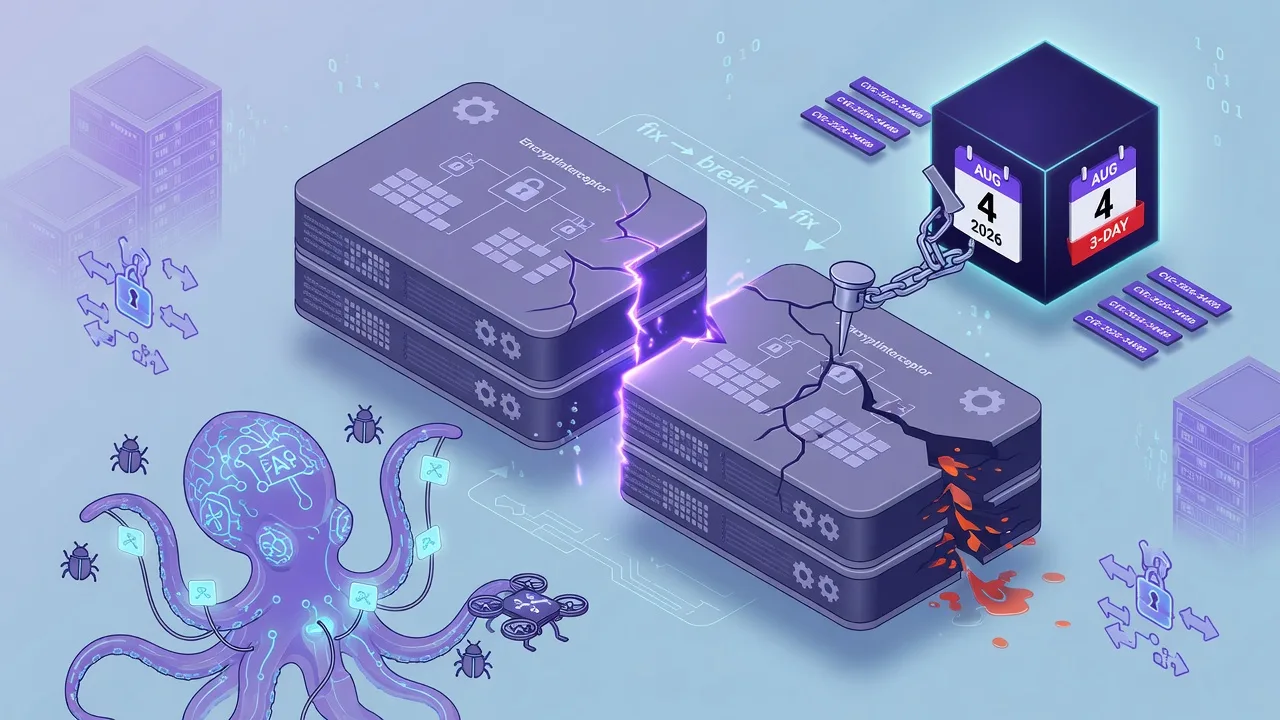
A three-day KEV deadline for a bug NVD rates two different ways
On August 4, 2026, CISA added CVE-2026-34486 — a bypass of Apache Tomcat's cluster-traffic encryption — to the Known Exploited Vulnerabilities catalog, alongside an IBM Langflow RCE and an N-able N-central auth bypass. What makes it a better story than a routine KEV add: the bug is the result of a fix that broke its own fix, NVD itself is showing two contradictory severity scores for it, and it sits on the same short exploit list as a newly documented autonomous AI hacking operator — though not quite in the way the initial headlines imply.
The bug that broke its own fix
Tomcat's EncryptInterceptor is an optional component of the Tribes clustering layer: it encrypts session-replication traffic between nodes in a multi-server deployment. In February 2026, Apache was told EncryptInterceptor's default CBC mode was vulnerable to a padding-oracle attack — tracked as CVE-2026-29146 (CWE-209/642/1240, Red Hat-rated 7.5 High). Apache fixed it. Then, during the same security review, a second report landed: the fix for CVE-2026-29146 itself let EncryptInterceptor be bypassed entirely — not weakened crypto, no encryption at all. That's CVE-2026-34486 (CWE-311 Missing Encryption of Sensitive Data, CWE-807 Reliance on Untrusted Inputs in a Security Decision).
From padding oracle to KEV in five months
- CVE-2026-29146 reportedPadding-oracle weakness in EncryptInterceptor's default CBC mode reported to the Apache Tomcat security team.
- CVE-2026-34486 reportedA follow-on finding during the same review: the in-progress fix for CVE-2026-29146 let EncryptInterceptor be bypassed outright.
- Both flaws disclosed togetherApache published both CVEs the same day and shipped 11.0.21 / 10.1.54 / 9.0.117 to close the bypass.
- Unit 42 publishes the AI-agent reportPalo Alto Networks details a Chinese-speaking actor (aliases knaithe / KnYuan) running DeepSeek through the open-source Hermes Agent framework as an autonomous offensive operator — Apache Tomcat appears on the same actor's list of manually-exploited known bugs.
- CISA adds CVE-2026-34486 to KEVAdded alongside an IBM Langflow RCE (CVE-2026-9198) and an N-able N-central auth bypass (CVE-2026-18556); federal deadline 2026-08-07.
| Tomcat branch | Affected version | Fixed version |
|---|---|---|
| 11.0.x | 11.0.20 | 11.0.21 |
| 10.1.x | 10.1.53 | 10.1.54 |
| 9.0.x | 9.0.116 | 9.0.117 |
NVD lists two official scores for the same CVE
Apache's own advisory doesn't publish a CVSS number at all — just the word "Important" on their internal severity scale. NVD's page shows no independent analyst score either ("NVD assessment not yet provided"). What it does show are two third-party ADP scores that disagree on the impact:
Same CVE, two risk models
- 9.8 — Critical
- AV:N/AC:L/PR:N/UI:N/S:U/C:H/I:H/A:H
- Models a worst case: bypassed encryption lets an attacker inject into cluster replication traffic, not just read it
- 7.5 — High
- AV:N/AC:L/PR:N/UI:N/S:U/C:H/I:N/A:N
- Models confidentiality-only impact: an attacker positioned on the cluster network reads unencrypted session traffic
The DeepSeek / Hermes Agent connection — and the manual exploit hiding in the same report
On 2026-07-30, Palo Alto Networks' Unit 42 published a report on a Chinese-speaking threat actor (aliases knaithe / KnYuan, publicly associated with a Zhuhai-linked handle that Unit 42 says is consistent with, but doesn't independently verify) who wired DeepSeek into the open-source Hermes Agent framework as an autonomous offensive operator. Hermes Agent supplied orchestration — terminal access, Telegram-based command-and-control, a skills system — while DeepSeek did the reasoning: target selection, exploit sourcing from GitHub, and code generation. Unit 42 recovered a full session in which the operator sent one Telegram command and the agent ran unattended from there. The actor attempted exploitation against more than 460 targets, mixing that autonomous pipeline with conventional manual tooling — and researchers only found any of this because the operator made an OPSEC mistake: a file server left running in the operation's home directory, exposing API keys, exploit scripts, target lists and AI attack logs.
| Target | Method (per Unit 42) | Outcome |
|---|---|---|
| IBM Langflow (CVE-2026-33017) | Autonomous — DeepSeek via Hermes Agent | Failed: restrictive target configuration |
| n8n (CVE-2026-21858 chained w/ CVE-2025-68613) | Autonomous — DeepSeek pivoted here after Langflow failed | Failed: required an authenticated file-upload form |
| Apache Tomcat (CVE-2026-34486) | Manual — one of the actor's known-bug exploits | Named alongside Citrix NetScaler, Marimo and IKE VPN endpoints; no autonomous attempt documented |
| Citrix NetScaler / Marimo / IKE VPN endpoints | Manual | Same manual list as Tomcat; no autonomous run described for these either |
One Telegram command, two exploitation paths
- Operator sends one Telegram command
- Hermes Agent orchestrates: terminal + Telegram C2 + skills
- DeepSeek reasons: target selection, exploit sourcing, code generation
- Autonomous attempt
- Manual, known-bug exploitation
- Langflow CVE-2026-33017 — failed
- n8n CVE-2026-21858 + CVE-2025-68613 — failed
- Tomcat CVE-2026-34486, Citrix NetScaler, Marimo, IKE VPN
What to actually do
- Upgrade to Tomcat 11.0.21, 10.1.54, or 9.0.117 depending on your branch. Apache's fix restores the encryption check the earlier patch removed; there's no config-only mitigation for the vulnerable builds.
- Running Tomcat via Red Hat JBoss Web Server or an EL-based image? Pull the matching RHSA erratum listed against CVE-2026-34486 and confirm the underlying package version, not just the container tag.
- Confirm you actually use EncryptInterceptor before treating this as urgent — it's an optional Tribes clustering component. Standalone, non-clustered Tomcat instances aren't exposed to this specific bug, though they may still be exposed to the earlier padding-oracle CVE-2026-29146 if unpatched.
- Federal agencies: CISA's KEV deadline was 2026-08-07. If you haven't patched a clustered, internet-reachable Tomcat by now, you're already past it.
Data as of 2026-08-05live record →