
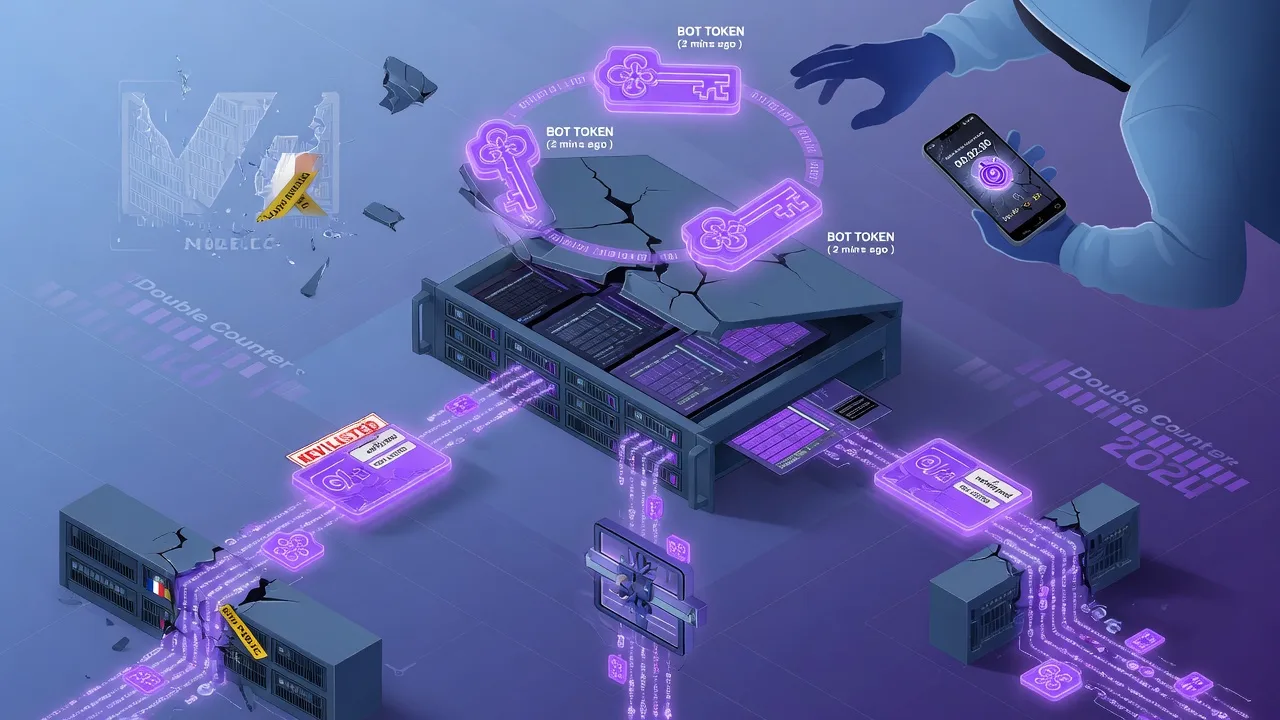
Double Counter Rotated Its Bot Token Mid-Breach. The Attacker Read the New One in Two Minutes.
A Discord anti-alt bot's "retired" server was still running Metabase, publicly reachable. The entry point matches a CVSS 10.0, KEV-listed bug — but the real failure was that one stolen credential unlocked three separate ways back in.
Double Counter, a Discord anti-alt-account bot used in more than 600,000 servers, was breached on October 4, 2026 — not through its production stack, but through an OVH server its operator, Tellter SAS, thought was already dead. Our read: the technical entry point almost certainly matches CVE-2026-72898, a CVSS 10.0 Metabase bug already on CISA's KEV list, but that's a side issue. The real story is that one compromised host handed the attacker three independent sets of cloud credentials, so revoking any one of them — including the bot's own Discord token, twice — did nothing. That's the part worth taking into your own environment.
The server that wasn't actually retired
Per Tellter's incident report, the attack didn't start against Double Counter's live infrastructure at all. It started against a leftover OVH server from a previous hosting setup — disconnected from the running service, but never actually taken off the internet. That box was still running a self-hosted Metabase instance, publicly reachable, with stored credentials nobody had rotated since the migration: an admin-rights cloud service-account key, and a saved administrator CLI session.
How the six hours went
INC-2026-10-04, per Tellter's own report (all times UTC)
- Reconnaissance beginsAttacker probes the legacy OVH server and an internal API from rotating VPN addresses, trying usernames like root, nathan, debian, analytics-sync, metabase.
- Legacy server compromisedAdmin session forged on the exposed Metabase instance; attacker reaches the host.
- First cloud accessAttacker uses the stolen cloud service-account key to enter Tellter's production Google Cloud project.
- Persistence + first exportAn SSH key is added; a ~5.0 GB database export is created in a storage bucket but never actually downloaded.
- Bot token stolenAttacker opens a shell inside a running Double Counter bot container and reads the live Discord bot token.
- Support server hijackedUsing the bot's identity, attacker grants itself admin and ~15 roles, gets banned by staff, un-bans itself via the bot, then starts posting invite spam into roughly 50 large Discord communities.
- First token rotationResponders invalidate the stolen bot token — their first containment move.
- Replacement token readThe attacker reads the newly-issued token within about two minutes of its deployment, straight out of a container that was never actually cleaned.
- Real exfiltration windowBackups deleted, database password changed, and roughly 12 GB of tables actually copied out — distinct from the earlier, undownloaded 5 GB export.
- Service-account key revoked, attacker falls backResponders kill the cloud key and the SSH key; attacker pivots to the still-live saved admin CLI session instead.
- Payment fraud via a separate productA payment key for an unrelated Tellter product ("Atis") is abused for 23 attempted charges totaling $7,331; 17 are declined. The key is revoked at 17:14.
- Full containmentAll admin sessions finally revoked — the third and last credential path closed.
- Service restoredDouble Counter comes back online on entirely new credentials.
Why rotating the token didn't end it
Tellter's responders did the textbook first move — they killed the leaked bot token at 13:39. It didn't matter, because the token was never the actual foothold. The attacker had three separate, independently-usable credentials that all traced back to the one compromised legacy host: the cloud service-account key, an SSH key it planted, and a pre-existing saved admin CLI session. Revoking the bot token closed none of them; revoking the service-account key (15:17) and the SSH key still left the admin session standing. Only killing all three, at 17:55, actually ended it.
What got rotated vs. what actually stopped the attacker
- Bot/Discord token (13:39) — re-read from a container in ~2 minutes
- Cloud service-account key (~15:17)
- Planted SSH key (~15:17–16:46)
- All admin CLI sessions revoked (17:55)
- Database closed off from the public internet
- Cache database moved to a private network
- No long-lived service-account key left in the project at all
What was actually exposed — and the gap between estimate and confirmed
Tellter's figures are deliberately conservative upper bounds — "what could have left," in the company's own framing — not a count of data known to be circulating. It's worth keeping those two numbers separate.
| Data category | Tellter's exposure estimate | Independently confirmed |
|---|---|---|
| Discord IDs / usernames | ≈28 million accounts | Not independently re-counted |
| IP addresses + coarse location | ≈27 million accounts | Not independently re-counted |
| User-agent hashes | ≈25 million accounts (fully copied) | — |
| Email addresses | ≈1.0 million accounts | 274.9K published, per Have I Been Pwned (added Oct 7, 2026) |
| Payment-customer records | ≈5,000 customers | A subset partially published |
| Passwords / card numbers | Not collected by the bot | None exposed |
The CVE, and the KEV timing that matters
CVE-2026-72898 is an unauthenticated SQL injection in Metabase's password-reset endpoint (CWE-89), scored CVSS 3.1 10.0 — the ceiling. Our data shows EPSS at 98.6%, 99.9th percentile: essentially guaranteed to be under active mass exploitation. It's CISA KEV-listed, first exploited as a zero-day around early August 2026 and patched in Metabase 0.58.24+ (and the equivalent later release lines). Per the vendor's own advisory, the bug works by injecting a crafted request into /api/session/reset_password that forges a session row in the core_session table tied to user_id = 1 — the first admin account created during setup — with no token, no login, no authentication at all.
CVE-2026-72898 is far from an isolated incident this year — track what else has landed on CISA's KEV catalog recently on our trends page.
What this is actually a lesson in
- Decommissioning means killing network reachability AND rotating every credential that host ever held — not just stopping it from serving the app it was built for.
- A stolen token is a symptom, not the root cause. If the same host also yields an SSH key or a cloud service-account key, rotating the token buys you nothing.
- Treat a saved CLI session the same way you'd treat a stored password: it's a standing credential, and it should expire on its own even if nobody ever steals the host it lives on.
- Audit any Metabase instance you still run — self-hosted or not — against CVE-2026-72898 specifically. The vendor's own detection guidance is to check the
core_sessiontable for admin sessions that were never preceded by a real login. - Scope service accounts narrowly. An admin-rights key sitting on an unmonitored legacy box is a loaded gun; a narrowly-scoped one limits exactly how much a forgotten server can cost you.
No public Sigma/Suricata/Nuclei rule is tracked for this CVE in our index as of writing. The one concrete indicator comes from Metabase's own advisory — use it, don't skip detection because nobody's published a signature yet.
CVSS/EPSS/KEV data as of 2026-10-26
Sources: Metabase Security Advisory GHSA-vwf4-m7j8-wcjf · CVE-2026-72898 record, CVE.org · CISA Known Exploited Vulnerabilities Catalog · Have I Been Pwned: Double Counter