
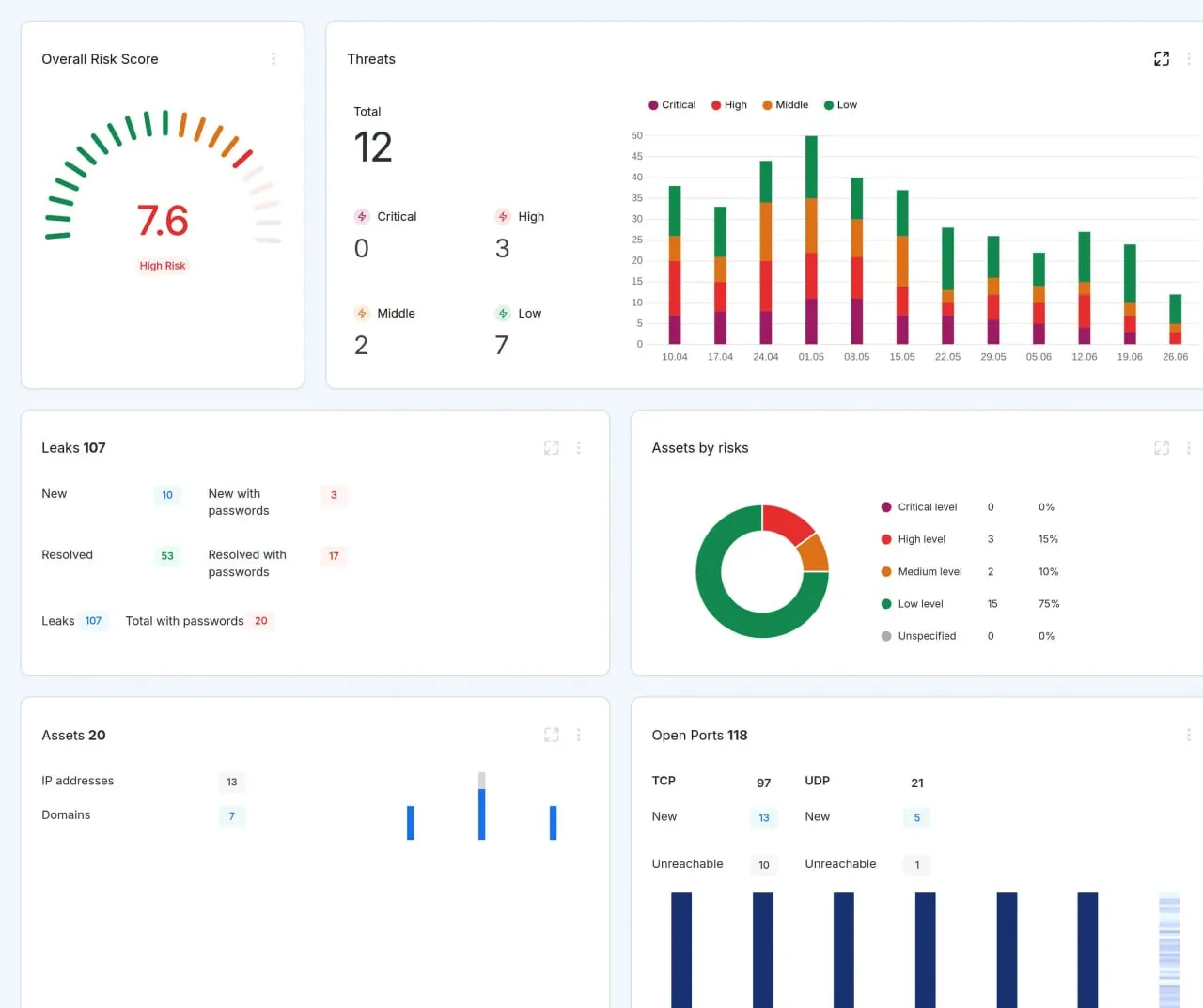
What does your company look like to a hacker?
Right now, anyone on the Internet can see parts of your business you can't — exposed logins, forgotten servers, and leaked employee passwords. It's the kind of thing attackers find first.
We'll show you exactly what they see — for free, with no software to install and no access to your systems. Not one domain checked by hand, but your whole external estate — hundreds of IPs and domains, scanned fast and monitored on a schedule.
New security flaws are disclosed every day — and the biggest companies aren't immune.
Attackers watch this stream constantly, looking for anything left exposed. If companies with huge security teams are affected this often, what about the systems no one is checking at yours?
New CVEs land every day. Some of them may already affect systems you run — the websites, servers and services your business exposes to the Internet. We'll show you which, for free.
Checking hosts one by one doesn't scale
One CVE on one server is a two-minute check. But you have dozens of domains, hundreds of IPs, and new critical CVEs land every week. Do it by hand and you're always behind — you find out you were exposed after someone else did. So we do it for you.
Every asset, not just the one you remember
Point us at your domains and IP ranges — we enumerate hundreds of internet-facing assets and check all of them. The ones you forgot about are usually the ones that get you.
Results in minutes, not a weekend
We run the checks across your whole external surface in parallel — a fraction of the time it takes to work through hosts by hand.
Scanned once, watched continuously
We re-scan on a recurring schedule and flag new exposure as it appears — a CVE published Tuesday doesn't sit on your perimeter until your next manual sweep.
We run it. You read the findings.
No tooling to set up, no false-positive triage. You get a prioritized list of what's actually exploitable on your infrastructure and what to fix first.
Your company has doors and windows facing the Internet.
Some you set up on purpose. Some you forgot about. We show you which ones an outsider can see — and which ones are unlocked. No jargon, just a clear picture.
Your websites & login pages
Every site, portal and login page of yours that anyone on the Internet can reach.
Forgotten systems
Old servers and services set up years ago and never shut down — the ones no one is watching.
Leaked employee passwords
Company logins that have turned up in public data breaches and are already out there.
Things left exposed by mistake
Services accidentally left open to the world that were only ever meant to be internal.
What your team put online
A developer or admin published a service, dashboard or test site — and no one told you it's now public.
You follow the threat landscape. The harder part is seeing your own external exposure.
You already follow vulnerabilities, threat intelligence and industry developments. What's often missing is visibility into what your own organization presents to the outside — the questions many teams struggle to answer:
- ? Are there publicly exposed employee credentials?
- ? What systems are actually exposed?
- ? Which assets have we forgotten about?
- ? What changed since our last review?
- ? Which findings deserve attention first?
- ? What should be escalated internally?
A clear picture of what your organization exposes to the Internet.
External asset discovery
Domains, subdomains, IP addresses and internet-facing services associated with your organization.
Security findings
Issues identified through external assessments of exposed services and applications.
Credential exposure
We check whether company accounts appear in public breach datasets — we never store or show plaintext passwords.
Unknown assets
Systems that may not appear in your existing inventory.
Exposure prioritization
Focus on externally reachable and actionable findings.
Technical evidence
Context your team can investigate and validate.
From your domain to a clear external picture.
You provide your domain
Your primary company domain. Optionally, add other domains or public IP addresses you'd like us to include.
We discover your attack surface
We identify internet-facing assets, services and systems associated with your organization — including assets you may not be actively tracking.
We review the exposure
We analyze discovered assets, identify external security findings and search for publicly exposed company credentials.
We contact you — and keep watching
We share the results, explain what deserves attention and answer your questions — then, if you want, keep re-scanning on a schedule so new exposure is caught as it appears.
What this review is — and isn't.
- →This review is not a penetration test.
- →It does not require access to your internal environment.
- →It is based on passive assessment of publicly available information — no intrusive testing is performed without explicit written authorization.
Its purpose is to provide an external perspective on what your organization currently exposes to the Internet.
The review is our introduction. Protection is what we do next.
We run the review, walk you through what we find, and tell you plainly what matters and what doesn't — at no cost and with no commitment.
It's the clearest way to show you what we do and the value we bring.
Your exposure changes constantly, so most teams choose to have it watched continuously — that's a paid service we offer. There's no obligation, and the review is worthwhile on its own.
A real security team reviews every request — by hand.
The team behind cve.tools are practicing penetration testers — ten years finding what companies expose.
We automated that work into a product: what used to take an expert days now runs continuously.
So we know which threats actually matter and which are noise — the same trends you see above, tracked daily.
Request your complimentary review.
All we need to begin is your primary domain. We'll prepare your External Exposure Review and contact you with the findings.
Your data: we only use the domain you provide and information that's already public — never your internal systems. We don't sell or share it, and you can ask us to delete it at any time. See our privacy policy.
Prefer to check a single CVE yourself? Self-check it free with Nuclei →
From request to findings — a clear process.
We review your request
Our team validates the domain scope and prepares your assessment.
We conduct the review
External asset discovery, security findings and credential exposure analysis.
We share findings
A walkthrough of results, prioritized recommendations and next steps.