
Three Actively-Exploited Zero-Days Hit Citrix NetScaler in Eleven Days. One Was Running Since Early September.
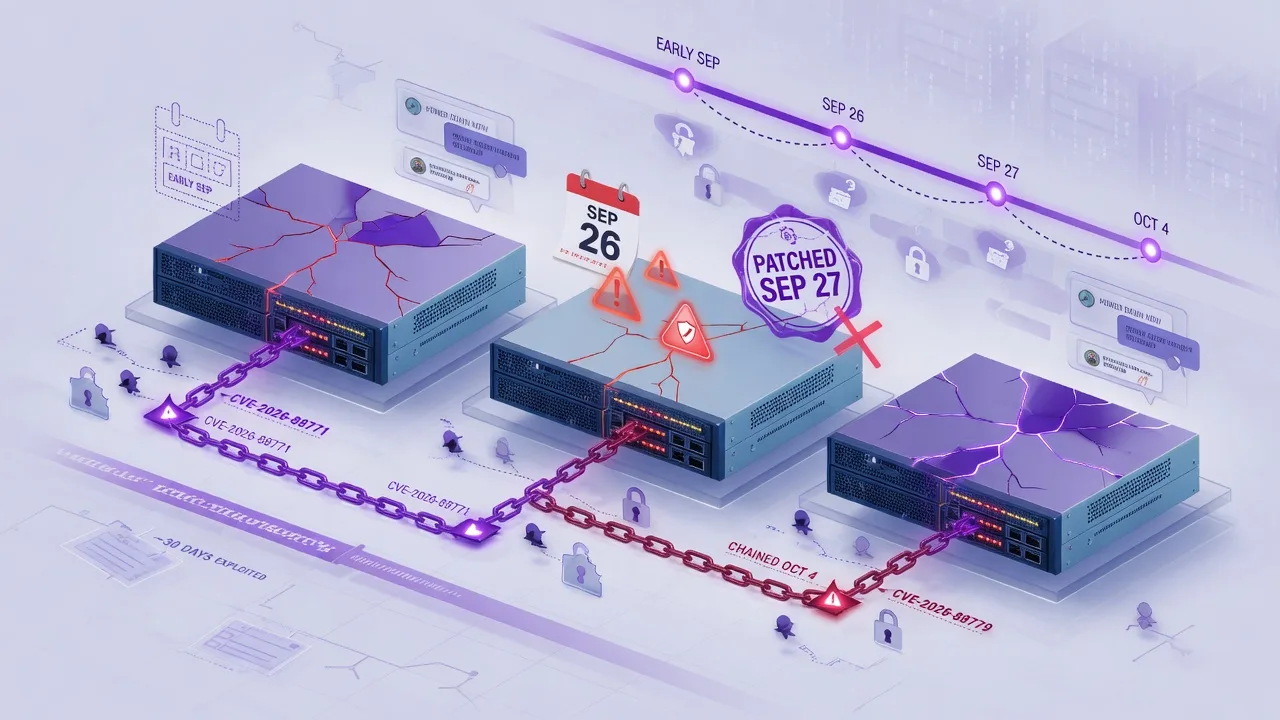
CVE-2026-88771 and CVE-2026-88772 were being exploited for roughly a month before Citrix shipped a fix on September 27 — then a third zero-day, CVE-2026-88779, landed October 4 and is already being chained with the first.
On September 26, 2026, admins in r/Citrix started reporting that their security teams had told them to power down NetScaler appliances — before Citrix had published anything. The next day, Citrix confirmed why: two critical remote-code-execution bugs, CVE-2026-88771 and CVE-2026-88772, had been exploited in the wild for weeks before anyone outside a handful of forensic investigators knew they existed. A week later, a third actively-exploited NetScaler bug landed, and researchers found it was already being chained with the first.
What the two September bugs actually are
CVE-2026-88771 is an improper-input-validation flaw (CWE-20) that lets an unauthenticated attacker run arbitrary commands. Citrix rates its attack complexity low, and watchTowr's writeup is blunt about the blast radius: it affects "every NetScaler ADC and NetScaler Gateway deployment on an affected version, including the default configuration" — no optional feature has to be switched on.
CVE-2026-88772 is a memory-overflow bug (CWE-119) that can trigger either RCE or denial of service, but only when DTLS is enabled on the appliance. Citrix rates its attack complexity high — harder to pull off than CVE-2026-88771 — but DTLS ships on by default for Gateway VPN virtual servers, so most Gateway deployments are exposed unless someone explicitly turned it off.
The exploitation timeline, from two independent vendors' telemetry
Pre- and post-disclosure exploitation of CVE-2026-88771 / CVE-2026-88772
- Reconnaissance beginsUnit 42 observed two hosts fingerprinting NetScaler Gateway via CSS/JS version-check requests; activity spread to 100+ systems within a day.
- CVE-2026-88772 exploitation startsFour rotating VPS hosts began requesting .deb installer files from /vpn/scripts/linux/ — the delivery path for a PHP web shell, per Unit 42.
- Earliest CVE-2026-88771 attemptsRapid7 logged two command-injection attempts using a crafted authentication string to archive the /flash/nsconfig directory to a public web path — not yet widespread.
- Targeted CVE-2026-88771 activityUnit 42 observed three-stage command-injection activity from three IPs against a U.S.-based target.
- Web shell deployedRapid7 observed a PHP web shell dropped at a NetScaler logon path on a second compromised organization.
- Last pre-disclosure requestUnit 42's last logged anomalous request, hours before Citrix published its bulletin.
- Public disclosureCitrix bulletin CTX697096 ships patches; CISA adds both CVEs to KEV the same day.
- Third zero-day disclosedCVE-2026-88779 (SAML denial-of-service) added to KEV; researchers report it's being chained with CVE-2026-88771.
CVE-2026-88771 exploitation chain (per Rapid7 / Unit 42)
- Version-check recon — CSS/JS requests fingerprint NetScaler Gateway build
- Crafted auth string → command injection
- Archive /flash/nsconfig to public web path
- Unauthenticated download of config, creds, keys
- PHP web shell dropped (.ctxs.receiver)
- Hardcoded-cookie RCE via passthru()
What to hunt for
45.61.136.143
66.227.183.84
77.83.199.39
104.28.215.137
104.248.244.66
104.28.247.136
162.33.178.9
193.149.176.207
216.245.184.164/vpn/scripts/linux/nsgclient18.deb
/vpn/scripts/linux/nsg64.deb
/var/netscaler/logon/LogonPoint/custom/.ctxs.receiverThen a third zero-day, chained with the first
On October 4, Citrix shipped bulletin CTX697174 for CVE-2026-88779, a memory-overflow bug (CVSS 7.5 in our v3.1 record) affecting NetScaler appliances configured as a SAML Service Provider or Identity Provider. Unlike the two RCE bugs, this one is a denial-of-service: a crafted request crashes the SAML authentication service, and the sixth crash in a row reboots the whole appliance. CISA added it to KEV the same day, with an aggressive three-day federal deadline of October 7 — a deadline that has already passed.
| CVE | Disclosed | CVSS (vendor v4.0 / our v3.1) | Impact | Default exposure | Fixed in |
|---|---|---|---|---|---|
| CVE-2026-88771 | Sep 27, 2026 | 9.5 / 9.8 | Unauthenticated RCE (CWE-20) | Every deployment, no config needed | 14.1-73.37, 13.1-64.23+ |
| CVE-2026-88772 | Sep 27, 2026 | 9.5 / 8.1 | RCE or DoS (CWE-119) | Gateway VPN with DTLS (on by default) | 14.1-73.37, 13.1-64.23+ |
| CVE-2026-88779 | Oct 4, 2026 | 8.7 / 7.5 | DoS, crash-loop reboot (CWE-119) | SAML SP/IdP configurations | 14.1-73.41, 13.1-64.28+ |
Citrix did a better job with their response to this vulnerability.
The patch you shipped in August doesn't cover this
If your NetScaler fleet was fully patched for CVE-2026-19490 — the authentication-bypass bug Citrix disclosed on August 19 — that patch (build 14.1-73.32 / 13.1-63.21) does not protect against CVE-2026-88771 or CVE-2026-88772. They're unrelated bugs on the same appliance, and the fixed builds for the new pair (14.1-73.37+, 13.1-64.23+) are newer than what the August patch cycle shipped. Appliances have to be upgraded again.
- Upgrade to 14.1-73.41, 13.1-64.28, or the matching FIPS/NDcPP build — this supersedes the Sept 27 fix and also closes CVE-2026-88779.
- Before patching, per CISA's BOD 26-04 forensic-triage requirement for both September CVEs: check for the IOCs above and preserve logs/memory where possible — patching first can destroy evidence of prior compromise.
- Check whether /flash/nsconfig or any backup of it was ever exposed; if CVE-2026-88771 was exploited before you patched, treat nsroot credentials, SSL private keys and SSH host keys in that directory as burned and rotate them.
- Reduce internet exposure of the management interface where you can't patch immediately — no config-level workaround exists for CVE-2026-88771 or CVE-2026-88772.
- If you run SAML SP/IdP on NetScaler, patch for CVE-2026-88779 even if you consider DoS low priority — it's the one now confirmed chained with an RCE bug.
CVE data and KEV status current as of 2026-10-11