
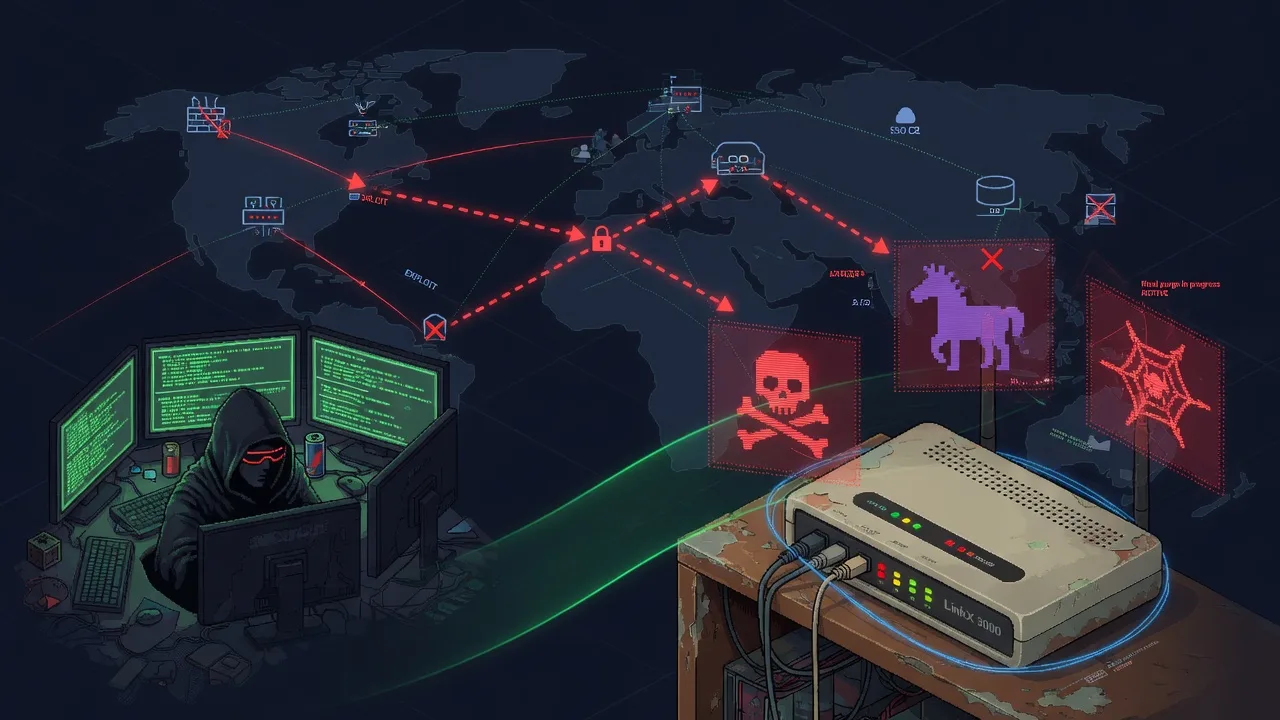
The Router Bug DD-WRT Patched in 2021 Just Became a Botnet's Front Door
CVE-2021-27137 sat fixed and mostly forgotten for five years. In July 2026, CISA put it on the KEV list anyway — because a Gafgyt variant called C0xmo is using it to break into routers, then kill every other botnet it finds already living there.
A bug that was supposed to be over
DD-WRT fixed CVE-2021-27137 within days of being told about it, back in March 2021. Nobody wrote it up as a big deal — the flaw needed UPnP enabled (off by default) and, per the researcher's own write-up, an attacker already on the local network. It looked like the kind of bug that quietly dies in a changelog. Five years later, on July 21, 2026, CISA added it to the Known Exploited Vulnerabilities catalog anyway. Not because the bug changed — because a modern IoT botnet called C0xmo started using it as one of its break-in tools, and CISA's job is to flag what's actually being exploited, not what looks urgent on paper.
What actually breaks
The flaw lives in router/upnp/src/ssdp.c, DD-WRT's handler for UPnP's SSDP discovery protocol. An M-SEARCH request sent over UDP to port 1900 can carry an ST:uuid: field of arbitrary length. DD-WRT copies that field with an unbounded strcpy into a fixed 128-byte stack buffer — no length check, no truncation. Send more than 128 bytes and you overflow the stack, which is enough for code execution (CWE-121). It was found by independent researcher Selim Enes Karaduman and disclosed through SSD Secure Disclosure on March 24, 2021. DD-WRT's maintainers responded the same way most small open-source projects do when a real bug lands in their inbox — fast: a fix shipped in changeset 45724, days later.
# From SSD Secure Disclosure's public write-up (not a working exploit as reproduced here):# an M-SEARCH request over UDP/1900 with an oversized ST:uuid value —# 164 filler bytes plus a 4-byte return-address placeholder —# crashes DD-WRT's SSDP service within seconds.# The overflow happens in ssdp_msearch(), inside ssdp.c.The five-year gap, mapped
CVE-2021-27137: disclosure to KEV
- Flaw disclosed via SSD Secure DisclosureSelim Enes Karaduman reports the ssdp.c buffer overflow; DD-WRT confirms and commits to a fast fix.
- DD-WRT ships changeset 45724The fix bounds-checks the ST:uuid field. CVE-2021-27137 goes quiet for half a decade.
- FortiGuard Labs first observes C0xmo exploiting itInitial target: a Japanese technology firm. The attacking source IP traced to an intermediary device in Germany.
- Fortinet publishes its technical report on C0xmoResearcher Vincent Li details the Gafgyt variant's architecture, propagation exploits and C2.
- CISA adds CVE-2021-27137 to KEVListed alongside a Langflow bug (CVE-2026-0770) and two WordPress core CVEs (CVE-2026-63030, CVE-2026-60137).
- Federal patch deadline under BOD 26-04Now three weeks past, as of this piece.
Meet C0xmo
C0xmo is a variant of Gafgyt (the Bashlite/Lizkebab lineage that, along with Mirai, has powered IoT DDoS botnets for the better part of a decade). Fortinet's write-up is blunt about it standing out from the pack: "a considerably more advanced architecture and feature set compared to earlier IoT botnets." The biggest structural change is that C0xmo splits its lateral-movement logic out into a standalone Python scanner, separate from the compiled bot binary — and that binary itself was compiled for seven different CPU architectures (ARM, MC68000, MIPS R3000, PowerPC, SuperH, Intel 80386, AMD64), which tells you the target list is anything embedded: routers, DVRs, NVRs, and Android devices among them.
How C0xmo spreads and takes over a device
- Python scanner sweeps UDP/1900 + Telnet/SSH — Also brute-forces weak Telnet/SSH creds and probes ADB on Android devices
- Oversized ST:uuid: in M-SEARCH overflows ssdp.c (CVE-2021-27137)
- Payload dropped to /tmp/.cache
- Persistence: hidden dirs, cron every 15 min, shell-profile hooks
- Scans /proc for rival botnets, security tools, dev utilities
- Deletes rival binaries + strips their persistence
- Handshake to C2 (magic string + shared secret)
- Bot available for 19 DDoS attack commands
The DD-WRT bug is one door out of many
CVE-2021-27137 isn't C0xmo's only way in — it's one entry in a scanner script that also carries exploits spanning more than a decade of embedded-device disclosures. That range is itself the story: none of these individually is new, but bundled together they cover most of what's still plugged in and unpatched on a home or small-office network.
| CVE / vector | Target | CVSS | Disclosed |
|---|---|---|---|
| CVE-2021-27137 | DD-WRT UPnP (ssdp.c buffer overflow) | 8.1 | 2021 |
| CVE-2015-2051 | D-Link DIR-645 HNAP command injection | 8.8 | 2015 |
| CVE-2022-35914 | GLPI htmLawed PHP code injection | 9.8 | 2022 |
| CVE-2025-34054 | AVTECH DVR Search.cgi command injection | 10.0 | 2025 (in-the-wild since Jan 2025) |
| CVE-2016-15047 | AVTECH CloudSetup.cgi command injection | 8.8 | 2025 (root cause dates to ~2016-17) |
| No CVE cited | Zyxel SysTools RCE, NVMS-9000, generic DVR/CGI shell injection | — | — |
| No CVE | Telnet/SSH weak-credential brute force, Android ADB abuse | — | — |
- 19 distinct DDoS attack commands, per Fortinet's teardown
- Volumetric floods: UDP, TCP, SYN, ICMP, ping of death
- Amplification: NTP and Memcached reflection
- Game/voice targeting: Discord voice UDP flood, FiveM flood, Valve Source Engine flood
- Bypass-oriented HTTP floods: Cloudflare-bypass GET flood, OVH-bypass TCP/UDP floods
- This is a commodity DDoS-for-rent toolkit, not an implant built for espionage or persistence-for-its-own-sake
What to actually do about it
- Update DD-WRT to changeset 45724 or later (current stable builds are well past this)
- Confirm UPnP is disabled unless you specifically need it — that's DD-WRT's own default
- If UPnP must stay on, verify it's bound to LAN-only interfaces and never exposed to the WAN side
- Watch for unexplained UDP/1900 traffic spikes, unknown cron entries, or hidden directories named .sys or .cache under /tmp, /var/tmp or /dev/shm
- Check outbound connections to Fortinet's reported infrastructure — 85.215.131.70 (C2), 217.160.125.125:15527 (payload/scanner distribution), 176.100.37.91 — treating these as historical indicators, since botnet infrastructure rotates
Data as of 2026-08-17