
SAP Commerce Cloud's CVSS 10.0 Data Hub Bug: Exploitation Attempts Started Three Days After the Patch
CVE-2026-58231 shipped on SAP's August Patch Day with no public PoC. Honeypots picked up probing on the following Friday anyway — a reminder that reading a patch diff has become faster than publishing an exploit.
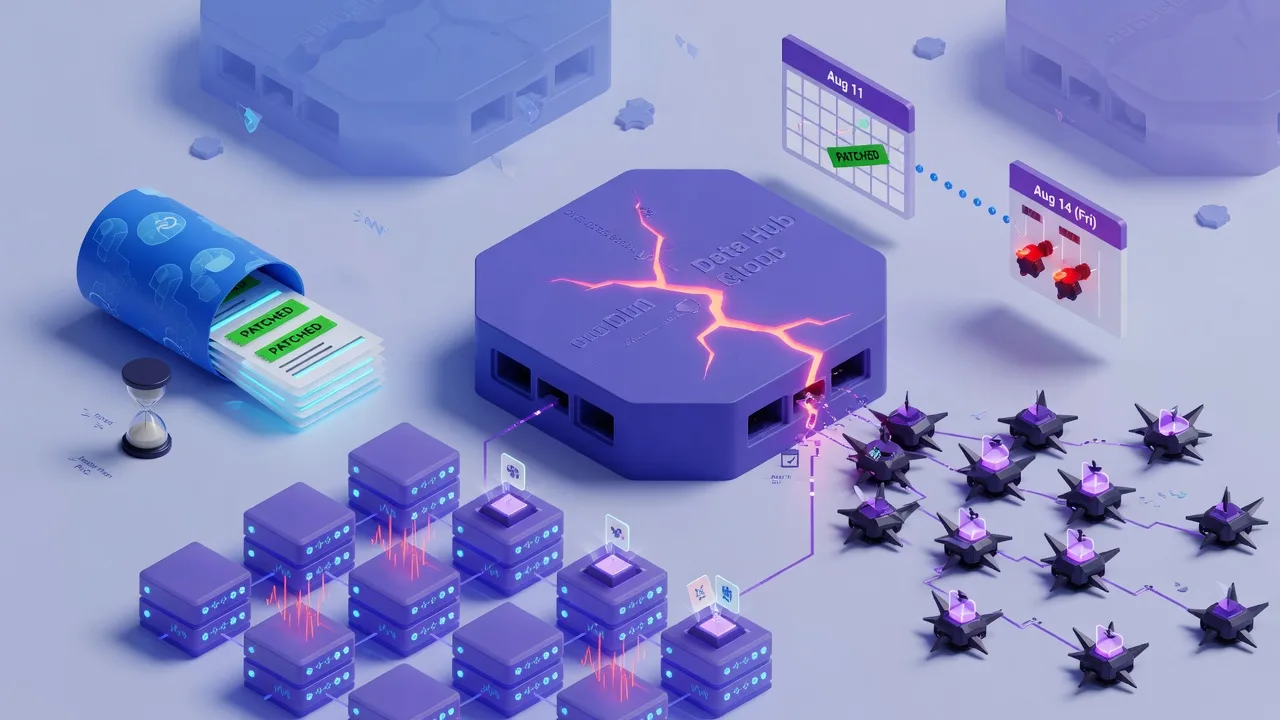
On August 11, 2026, SAP's monthly Patch Day fixed CVE-2026-58231: a maximum-severity flaw in SAP Commerce Cloud's Data Hub Adapter that lets a fully unauthenticated attacker abuse a default authentication client to reach arbitrary code execution. No public proof-of-concept ever surfaced. Three days later, honeypot telemetry showed someone probing for it anyway.
What the vulnerability actually is
SAP's own description is unusually direct for a vendor advisory: "SAP Commerce Cloud allows an unauthenticated attacker to abuse a default authentication client and submit specially crafted input to certain functions lacking sufficient validation. Successful exploitation could enable arbitrary code execution and compromise internal components." That's an unauthenticated attacker, on the network, with no credentials, reaching code execution — the reason it caps out CVSS at 10.0 rather than a merely-critical 9.x.
| Field | Value |
|---|---|
| CVSS vector | AV:N/AC:L/PR:N/UI:N/S:C/C:H/I:H/A:H (3.1) |
| Scope | Changed — impact extends past the vulnerable Data Hub Adapter into other internal components |
| Affected | SAP Commerce Cloud, Data Hub Adapter extension — releases 2211 and 2211-JDK21 |
| Fix | SAP Security Note 3771065, published August 11, 2026 Patch Day |
| Public PoC / exploit code | None known as of this writing |
| Workaround short of patching | None documented by SAP; a network-level mitigation exists (below) but doesn't fix the flaw |
The timeline: patch, then probe
CVE-2026-58231, three days in
- SAP ships the fixSecurity Note 3771065 lands as part of SAP's August Patch Day — 28 new notes, four rated Critical.
- No known exploitation, publiclyThreat-intel firm Defused publicly noted the flaw "has no public PoC and is not known to be exploited" — the baseline before things changed.
- Honeypots light upDefused reported the first exploitation attempts hitting its honeypot systems. KEVIntel independently confirmed activity — two attempts from a single US-based IP address.
- Coverage catches upBleepingComputer and The Hacker News report the exploitation attempts; Shadowserver's scan counts over 4,200 internet-facing hosts fingerprinted as SAP Commerce Cloud.
EPSS didn't see this coming — and that's not really a knock on EPSS
At the time of writing, CVE-2026-58231 carries an EPSS score of roughly 0.7%, sitting at the 51st percentile — squarely average, nowhere near the top of the exploitation-likelihood distribution. That's expected: EPSS models the kind of opportunistic, internet-wide scanning that shows up when a PoC goes public and script kiddies pile on. A patch-diffed, low-volume, single-IP probe against a niche enterprise middleware component three days after a fix ships is a different threat model entirely — reverse-engineering, not mass scanning. The CVSS 10.0 tells you the ceiling if it's exploited; EPSS was never built to predict this particular kind of early, surgical activity.
Mitigation: a stopgap exists, but it isn't a fix
SAP's guidance, echoed by the enterprise-security firm Onapsis, is to patch — full stop. "Customers must patch to the fixed Commerce Cloud release levels referenced in the note and re-build/re-deploy the updated SAP Commerce Cloud version," Onapsis wrote, which is a heavier lift than a config toggle: it means rebuilding and redeploying the environment. For anyone who can't do that immediately, Onapsis also flagged a narrower option: "customers can reduce their exposure by configuring an IP Filter Set in SAP Commerce Cloud to restrict access to the vulnerable endpoint."
The rest of an unusually heavy Patch Day
CVE-2026-58231 was the most severe of four Critical-rated notes SAP shipped on August 11 — the other three are worth knowing about even though they're outside this article's scope.
| CVE | Component | CVSS | Notes |
|---|---|---|---|
| CVE-2026-58231 | Commerce Cloud, Data Hub Adapter | 10.0 | Unauthenticated code execution — this article |
| CVE-2026-44772 | Manufacturing Integration and Intelligence | 9.9 | Code injection via crafted input to vulnerable servlets, no privileges required |
| CVE-2026-44758 | Manufacturing Integration and Intelligence | 9.1 | Similar code-injection class, but requires higher privileges than CVE-2026-44772 |
| CVE-2026-34265 | NetWeaver AS ABAP / ABAP Platform | 9.8 | Memory corruption in DIAG protocol parsing, exploitable without authentication |
SecurityWeek's coverage of the batch noted SAP found no evidence any of the August notes — critical or otherwise — were being exploited at disclosure time. CVE-2026-58231's honeypot activity three days later is specific to that one flaw, not a sign the whole batch is under attack.
SAP Commerce Cloud has been here before
This isn't the platform's first maximum-severity, pre-auth code-execution bug, and it isn't SAP's first time watching a patch get reverse-engineered fast. CVE-2019-0344 — unsafe deserialization in Commerce Cloud's virtualjdbc extension — later made CISA's Known Exploited Vulnerabilities catalog. More recently, CVE-2025-31324, a missing-authorization flaw in a different SAP product (NetWeaver Visual Composer), was added to KEV within weeks and went on to be used by ransomware affiliates; its EPSS sits at the 99.9th percentile, worlds apart from where CVE-2026-58231 sits today.
CVE-2026-58231 vs. the last SAP bug that mattered
- EPSS ~0.7%, 51st percentile
- Two confirmed exploitation attempts, one IP
- No public PoC as of writing
- Not yet in CISA KEV
- EPSS 99.5th+ percentile
- Mass exploitation, multiple ransomware crews
- Public PoCs circulated widely
- Added to CISA KEV
What to actually do
- Identify whether your SAP Commerce Cloud deployment runs the Data Hub Adapter extension on release 2211 or 2211-JDK21 — this is not affected across every SAP Commerce Cloud install.
- Apply SAP Security Note 3771065 by rebuilding and redeploying the patched release; this is not a hot-patchable config change.
- If an immediate rebuild isn't possible, restrict network access to the Data Hub Adapter's import endpoint via an IP Filter Set as a temporary reduction in exposure — and track it as technical debt, not a fix.
- Check external exposure: Shadowserver's count of 4,200+ internet-facing SAP Commerce Cloud fingerprints is a reminder that a fair number of these deployments are reachable from the open internet at all.
Data current as of 2026-08-19live record →