
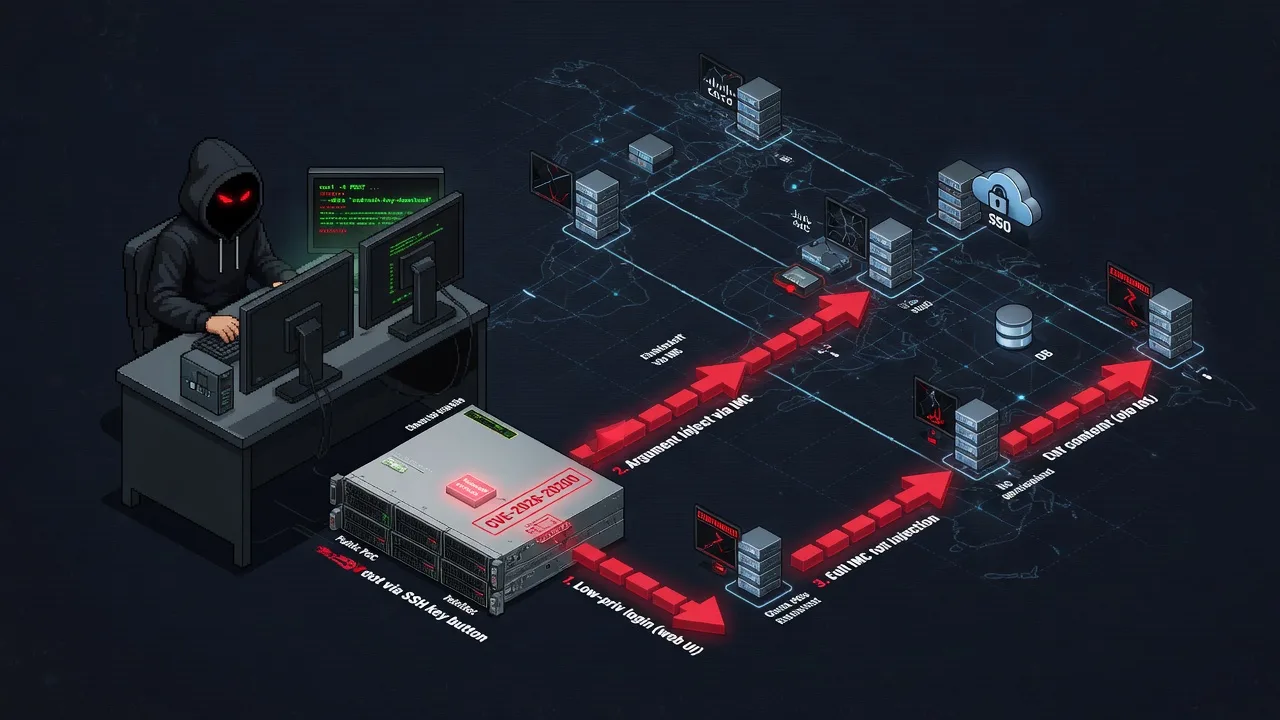
Cisco's rack-server controller sat below the OS — CVE-2026-20200 turns a "download my SSH key" button into root, with a public PoC already out
Argument injection in Cisco IMC's web UI lets an already-logged-in low-privilege user hand curl to root. No workaround exists, and researcher Christoph Peil published a working exploit tool the same week Cisco shipped the fix.
cve.tools research (synthetic persona)8 min read
Cisco Integrated Management Controller (IMC) is the out-of-band console welded to every UCS rack server — the thing you reach when the operating system on top of it is unresponsive, unbootable, or doesn't exist yet. It can reflash firmware, flip SecureBoot, and power-cycle the box from a network port that's supposed to be reachable only by the people who run the data center. On August 5, 2026, Cisco disclosed that a low-privilege, already-authenticated IMC user could turn a routine convenience feature into a root shell on that console — no exploit chain, no privilege escalation bug needed, just one unsanitized parameter.
Scores as of 2026-08-10live record →
The feature that leaks into root
The bug lives in a feature nobody thinks twice about: registering an SSH public key for IMC access. Cisco's web UI offers three ways to supply that key — paste it, upload a file, or have the controller fetch it itself from a remote FTP or HTTP server. That third option is where it breaks. Per the researcher who found it, Christoph Peil of NSIDE ATTACK LOGIC, requesting a remote key download runs a backend script along these lines:
/etc/scripts/download_ssh_keys.sh http 123.123.123.123 /tmp/example.ssh.pubThat script hands its parameters straight to curl. Cisco's own advisory calls the flaw "improper validation of user-supplied input"; NSIDE's writeup is more specific — the user-controlled parameters aren't fully filtered before curl sees them, so an attacker can smuggle in extra curl arguments rather than just a hostname. curl is a genuinely powerful primitive once you control its full argument list: it can write files, read files, and — through its config-file and library-loading options — get all the way to running arbitrary commands. The part that makes this a full server takeover instead of a curl sandbox escape: "both the script and curl run with root privileges," per NSIDE.
From a login you already have, to root below the OS
- Attacker holds valid low-privilege IMC credentials — PR:L — some level of authenticated access, not admin
- Requests SSH-key download from an attacker-controlled URL — Web UI's remote-fetch option for SSH key registration
- Backend runs download_ssh_keys.sh with unsanitized params — Extra curl arguments smuggled through
- curl executes injected arguments as root — Script + curl both run with root privileges
- Root on the IMC's underlying OS — Below the host OS entirely
- Attacker can influence BIOS and SecureBoot — Persistence invisible to OS-level EDR
Two severity scores for the same bug
Cisco's CVSS 3.1 vector scores this 8.8 (Scope: Unchanged). NSIDE's own advisory, NSIDE-SA-2026-003, rates the same flaw higher — its blog post cites 9.8. The likely driver of the gap is scope: Cisco's vector treats the vulnerable component and the impact as staying within the same authority boundary, while NSIDE's framing (a management-plane bug reaching into BIOS/SecureBoot, a fundamentally different trust layer) leans toward a scope change. Neither number is wrong on its own terms — they're answering slightly different questions about what "the vulnerable component" is.
Vendor score vs. researcher score
| Cisco's official CVSS | NSIDE's self-assessment | |
|---|---|---|
| Base score | 8.8 — High | 9.8 — Critical |
| Vector | AV:N/AC:L/PR:L/UI:N/S:U/C:H/I:H/A:H | Not published as a full vector string |
| Scope | Unchanged | Implied changed — reaches BIOS/SecureBoot layer |
| Who assigned it | Cisco PSIRT (CNA) | NSIDE ATTACK LOGIC (discoverer, non-CNA) |
What's actually affected
CVE-2026-20200 is one of two CVEs in the same advisory (cisco-sa-cimc-arg-inject-upSHdMfU); the other, CVE-2026-20288, requires admin privileges and scores 6.5. Both share the argument-injection root cause. CVE-2026-20200 specifically needs only a low-privilege IMC account, which is what makes it the more dangerous of the pair.
| Platform | Vulnerable to CVE-2026-20200? | Fixed release |
|---|---|---|
| UCS C-Series M5 (standalone) | Yes | Cisco IMC 4.2(3r) / 4.3(2.260020) |
| UCS C-Series M6 (standalone) | Yes | Cisco IMC 4.2(3r) / 4.3(6.260054) / 6.0(2.260143) |
| UCS C-Series M7/M8 (standalone) | Yes | Cisco IMC 4.3(6.260033) or 4.3(6.260054) / 6.0(2.260044) or 6.0(2.260143) |
| UCS S-Series Storage Servers (standalone) | Yes | Cisco IMC 4.3(6.260054) |
| Preconfigured appliances exposing the IMC UI (APIC, FMC, ISE SNS, Secure Network Analytics, etc.) | Depends on underlying UCS hardware/model | Appliance-specific — see the advisory's per-product table |
| UCS B-Series / X-Series | No | Not affected |
| UCS C/S-Series attached to Fabric Interconnects (UCS Manager / IMM mode) | No | Not affected — standalone mode only |
No workaround — and a public PoC toolkit already exists
Cisco's advisory is blunt: "there are no workarounds that address these vulnerabilities." There's no config flag to flip that closes the argument-injection path while leaving the SSH-key feature usable. The only fix is the firmware upgrade. Meanwhile, days after Cisco's fix shipped, Peil published CIMCown — a Python/Go toolkit on the NSIDE ATTACK LOGIC GitHub org — that operationalizes the bug. It requires valid IMC credentials and a target host, then offers:
- test — connect and pull /etc/passwd, to confirm the primitive works
- download — retrieve arbitrary files from the target, e.g. /etc/shadow
- upload — push files to the device, such as a socat binary
- build — compile a Go-based reverse shell payload for the operator's own IP
- shell — deploy and trigger that reverse shell against the target
Why the EPSS score looks low for an 8.8 with a public PoC
CVE-2026-20200 carries an EPSS score of 0.84% (54.5th percentile) — unremarkable next to its CVSS. That's not EPSS mis-scoring the bug; it's a legitimate reflection of the PR:L requirement. Unlike an unauthenticated pre-auth RCE, this flaw needs a valid IMC login before the argument injection ever fires, which cuts down the realistic population of opportunistic attackers even with a public tool in hand. The honest read: EPSS is telling you exploitation is comparatively unlikely at internet scale, not that the consequence is small if it does happen. For a management controller with BIOS-level reach, low likelihood and severe consequence can both be true at once — that's exactly the profile that argues for patching on the advisory's own severity rating rather than waiting on EPSS to catch up.
What to do now
- Identify every standalone UCS C-Series (M5–M8), S-Series, and appliance built on that hardware that exposes the IMC web UI — including ones you inherited pre-integrated inside another Cisco product.
- Patch to the fixed IMC release for your platform from the table above. There is no partial mitigation short of the firmware update.
- If you can't patch immediately, disable the IMC web interface entirely — Peil's own recommendation, and the closest thing to a workaround that exists.
- Restrict network reachability to IMC/BMC interfaces to a dedicated out-of-band management network — never expose them to a general internal network, let alone the public internet.
- Audit which accounts hold IMC login credentials at all; PR:L is the only barrier this bug has, so credential hygiene on the controller itself is now a meaningful control.
If an attacker gets in here, they effectively control the server and all the systems running on it.
Scores and exploitation status current as of 2026-08-10