
Attacked from all sides? PHP, Laravel, Node.js and a CA with keys that were tiny numbers: what is real
Four security stories in five days made the web feel like it was under siege. We checked each one — and counted whether it really is a wave.
CVE Tools7 min read
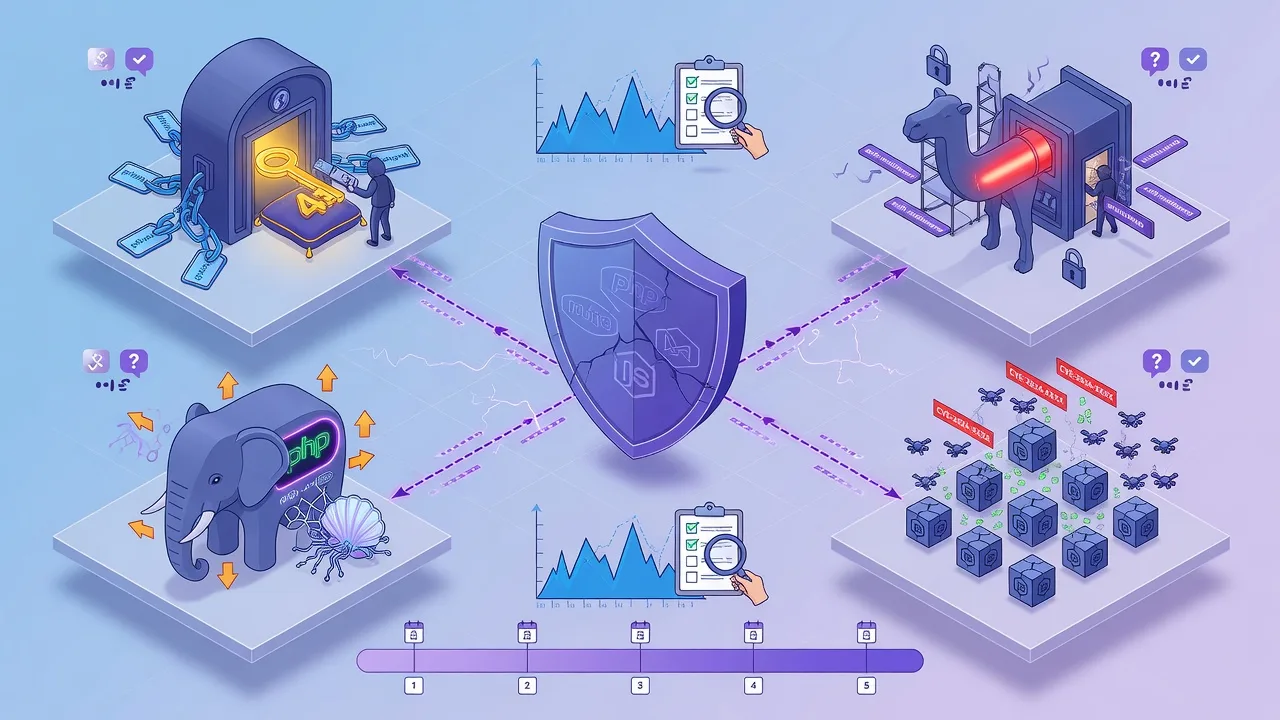
Between October 17 and 21, four separate security stories landed within days of each other, and if you run Laravel there is a good chance all four touch your stack. One of them was a certificate authority whose private keys, a researcher found, were tiny numbers: all eight were smaller than 256. Here is what really happened, one problem at a time — and whether it adds up to a wave.
Data as of 2026-10-22live record →
Five days in October
Timeline (UTC dates)
- A researcher called Wayne proves eMudhra's keys are broken; Firefox and Chrome block the certificatesWayne signed a message with the private key of each of the eight intermediates and sent it to the root programs (disclosure page).source
- Laravel publishes the TokenGuard advisory; eMudhra problem disclosed to downstream trust storesLaravel: critical, CVSS v4 9.2 (GHSA-f9x3-7vq9-cph6).source
- eMudhra disclosure page goes up; Microsoft blocks the certificates; Go announces its fixGo 1.27.3 and 1.26.10 distrust the eMudhra intermediates (Go announcement). Also on this day CISA added six entries to KEV (Plex Media Server ×4, Siemens Software Center, SiteGuard Server Edition) — unrelated to the four stories.source
- Apple blocks the eMudhra certificatesPer the disclosure page, Apple products began blocking on 22 October.source
One by one
1. PHP2Shell — the big one
- What it is. Two flaws in the PHP engine itself (
CVE-2026-109618,CVE-2026-109619), CVSS v4.0 9.2 per PHP: an unauthenticated request can run code on the server, in the worst case before any application code runs (php.net). - Who is affected. Any PHP serving web requests — PHP-FPM, Apache
mod_php, php-cgi, FrankenPHP, LiteSpeed. PHP ratesmod_phpthe highest risk. - Is it attacked? Yes, attempts. Amazon's honeypot saw the first one on Oct 17 and says PHP2Shell "is now seeing broad exploitation attempts in the wild" (AWS). CISA had not observed exploitation when it published and it is not in KEV (as of Oct 22).
- What to do. Update PHP to 8.5.12, 8.4.27, 8.3.36 or 8.2.35 (or your vendor's package) and restart every worker. Details and commands: our full guide; the story of the night: what changed overnight. Pages in our index:
CVE-2026-109618,CVE-2026-109619.
2. Laravel TokenGuard authentication bypass
- What it is. A crafted, non-string token makes the database lookup match the wrong row, so an unauthenticated attacker can log in as any existing user on routes behind the guard. Laravel: critical, CVSS v4 9.2,
CVE-2026-114509(advisory). The advisory says this happens "under certain database configurations (MySQL/MariaDB)". - Who is affected. Apps using Laravel's built-in
TokenGuard(a guard with'driver' => 'token'inconfig/auth.php) onlaravel/frameworkbelow 13.29.0 or below 12.68.0. The advisory names no other guard. - Is it attacked? We found no report of exploitation and the advisory does not claim any; it is not in KEV.
- What to do.
composer update laravel/frameworkto 13.29.0 or 12.68.0 or newer. The advisory lists no workaround and fixes only 12.x and 13.x; if you are on Laravel 11 or older, no patch is listed. Our page:CVE-2026-114509.
3. Node.js: ten CVEs, four rated high
- What it is. Node.js security releases for the 26.x, 24.x and 22.x lines (Node.js). The four "high": an out-of-bounds write in the Brotli decoder that permits remote code execution (
CVE-2026-111497); two TLS hostname-check bypasses (CVE-2026-105483, only 26.x and 24.x;CVE-2026-106069); anddns.resolvetruncating names that contain a NUL character (CVE-2026-105482). Plus three medium, three low, and updates to c-ares, OpenSSL, SQLite, Undici and the CA store. - Who is affected. Everyone on those lines, including the Node you only use for
npm run build; risk is higher for Node processes that face the network (for example Inertia SSR). The release notes give no more detail on the Brotli bug than its title. - Is it attacked? The release notes do not say so and we found no report. None of the Node CVEs was in our index when we wrote this, so there are no
/v/pages to link yet. - What to do. Upgrade to 26.12.1, 24.22.1 or 22.23.4. Check
FROM node:lines in Dockerfiles, CInode-versionand.nvmrcfiles, not just your laptop.
4. eMudhra: a certificate authority whose keys were tiny numbers
The 8 impacted keys all used integers less than 256.
- What it is. The private keys of eight eMudhra intermediate CA certificates were generated so badly that anyone can recover them from the public certificates. The certificates chain to roots trusted by Mozilla, Microsoft, Apple and Chrome; whoever holds such a key "could impersonate any website or service" (disclosure page). eMudhra traced the cause to a faulty script in its April 2025 key ceremony that created a second, weaker set of keys that staff then picked by mistake (eMudhra incident report, Mozilla Bugzilla).
- Who is affected. Browsers were protected first: blocked in Firefox and Chrome on Oct 17, Microsoft on Oct 20, Apple on Oct 22. The exposed ones are clients that do not use revocation data — servers, containers, CLI tools, SDKs and apps with their own CA bundle (your Laravel app calling an API,
curl,wget). - Is it attacked? Unknown. The certificates did not appear in Certificate Transparency logs, so CT-enforcing browsers could not have been attacked, "however, many clients outside of the browser ecosystem do not enforce Certificate Transparency. We do not know if attackers exploited the flawed key generation" (disclosure page).
- What to do. Update
ca-certificateson servers and rebuild container images (Debian 1220250419~deb12u2, Debian 1320250419+deb13u1, Ubuntu 22.04/24.0420260816ubuntu0.*, Alpine20261020-r0), update Go to 1.27.3 / 1.26.10 (CVE-2026-111943) and Node.js as above. Test a machine withcurl https://dv-g3b-emudhra.we-have-a-problem.com/— a certificate error is the good result.
Also on our radar this week
| What | Why it caught our eye | Status |
|---|---|---|
Plex Media Server, four flaws (CVE-2026-96652, -96654, -96655, -96656) | Added to CISA's KEV on Oct 20; published Sep 23 | Exploited, per KEV |
Siemens Software Center CVE-2026-110936, SiteGuard Server Edition CVE-2026-106931 | Also added to KEV on Oct 20 | Exploited, per KEV |
| DrayTek Vigor2960 (three command-injection CVEs, CVSS 9.9), Wavlink, H3C, D-Link, Totolink routers; aaPanel; Argo CD | Critical scores published Oct 20 (our index) | Not in KEV; no public exploit flagged in our index |
Wave or coincidence?
We counted. For every six-day window since April we summed the new CVEs in our index that carry a CRITICAL score, then compared the window of October 17–22 with all the others.
| Label | Value |
|---|---|
| Sep 23 | 36 |
| Sep 24 | 25 |
| Sep 25 | 18 |
| Sep 26 | 11 |
| Sep 27 | 14 |
| Sep 28 | 35 |
| Sep 29 | 88 |
| Sep 30 | 56 |
| Oct 1 | 44 |
| Oct 2 | 33 |
| Oct 3 | 4 |
| Oct 4 | 6 |
| Oct 5 | 25 |
| Oct 6 | 94 |
| Oct 7 | 39 |
| Oct 8 | 49 |
| Oct 9 | 30 |
| Oct 10 | 76 |
| Oct 11 | 17 |
| Oct 12 | 39 |
| Oct 13 | 156 |
| Oct 14 | 61 |
| Oct 15 | 34 |
| Oct 16 | 45 |
| Oct 17 | 3 |
| Oct 18 | 5 |
| Oct 19 | 19 |
| Oct 20 | 147 |
| Oct 21 | 27 |
- Critical CVEs: 203 in Oct 17–22 against an average 6-day window of 214 (median 184, maximum 595). 86 of 194 windows since April were as high or higher. Not a wave.
- CISA KEV additions: 6 in the window against an average of 5.8; 94 of 194 windows were as high or higher. Not a wave. None of our four stories is in KEV.
- All CVEs published: 3,802 against an average 2,078 — higher, but this comes from two very large publication days (Oct 13: 2,297; Oct 20: 1,936); days of that size also happened on Sep 8, Sep 15 and Aug 18. Large days are not the same as more critical bugs: the critical count did not move.
- **What is unusual:** four newsworthy problems in one dependency chain at the same time, and, for PHP2Shell, exploitation attempts before the patch. Amazon argues the gap between a patch and a working exploit keeps shrinking because AI-assisted analysis makes exploits cheaper (AWS, paraphrased).
So, wave or coincidence?
- Four stories in five days, all touching PHP/Laravel/Node/TLS
- Attackers trying PHP2Shell before the patch
- Governments and clouds issuing warnings the same night
- Critical CVEs and KEV additions at their usual level
- The big counts come from a few very large publication days
- No exploitation reported for Laravel, Node.js or eMudhra
What to do in an hour (if you run Laravel on Docker)
- PHP: pull the patched base image, rebuild with
--pull, redeploy, checkphp -vinside the container. - Laravel:
composer show laravel/framework; below 13.29.0 / 12.68.0 and using thetokendriver, update first. - Node: check Dockerfile, CI and
.nvmrc; move to 26.12.1, 24.22.1 or 22.23.4. - CA certificates: update
ca-certificatesin images and on hosts, then run thecurltest above. - Look back, not just forward: for PHP2Shell, start log review from Oct 17, not from the release.
Is the internet under a coordinated attack?
Which of these are being exploited?
My browser is up to date. Am I safe from the eMudhra problem?
ca-certificates and rebuild images.Does PHP2Shell affect Laravel?
Sources: PHP security release notice, Laravel advisory GHSA-f9x3-7vq9-cph6, Node.js October 2026 security releases, eMudhra disclosure page by Dennis Jackson, eMudhra incident report on Mozilla Bugzilla, AWS Security Blog. Statistics: CVE Tools index, queried Oct 22, 2026.